Virtualization, Cloud, Infrastructure and all that stuff in-between
My ramblings on the stuff that holds it all together
Daily Archives: October 31, 2007
Managing lots of RSS feeds
Posted by on October 31, 2007
I’ve been into reading people’s blogs and tracking websites like theregister for a good couple of years. I never really found an RSS reader app that worked for me; I wanted to build custom views of feeds, flag and prioritize them and mark things to read later – and I could find standalong apps to do these things but not one that did it all – hopefully this post will show you how I do it – if you have some other suggestions feel free to comment & share them.
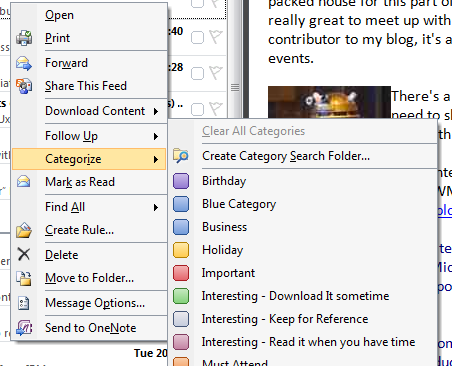
Outlook 2007 supports RSS feeds out of the box, and it’s ideal as I already use Outlook and it’s calendar/tasks features to manage my workflow. Outlook 2003 and later (I think) added the ability to flag and tag items and even build a custom category list.
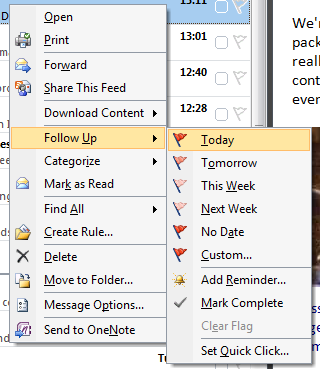
It means I can basically add all my RSS feeds as sources of information in the same way as I use it to manage my company emails, and categorise, flag as required and it all merges with into task list.
I can do this categorization manually or I think automatically via a rule
Custom Categories
Flagging – which passes it into Outlook’s task list
I have two main folder/sub-folder structures – regular reads, for feeds that have a lot of frequent/interesting traffic and another folder/sub-folder structure for less noisy but important feeds (for example software release notifications etc.)

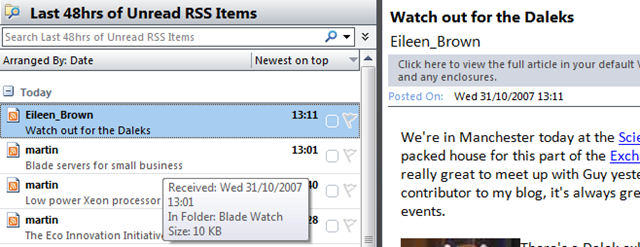
Best of all I can build custom views across of all my RSS feeds using custom search folders – for example I have the following (yes, and lots of unread emails too!)

And this gives me the following consolidated view across all my feeds, sorted by date (but could be lots of other criteria)
The add feed GUI components definitely have the feel of an afterthought but using them works brilliantly for me. Clicking on a page’s RSS feed brings up Outlook but doesn’t want to add it as a feed so I’ve always cut & pasted.. I assumed this was a beta bug but have been using RTM for quite a while now – must get round to investigating that.
Technorati Tags: Microsoft , office , 2007 , Outlook , Cool ways to do things , RSS , managing feeds
Tiny Laptop for £229 with solid state HDD
Posted by on October 31, 2007
I generally wouldn’t touch anything other than a Dell/HP/IBM laptop with a bargepole for reasons of spares availability/cost… but at £229 inc VAT this is almost disposable if something dies.

It’s tiny and has a (small) solid state HDD but SD card reader slot to allow you to add more storage space.
Review here..
http://www.cnet.co.uk//i/c/rv/e/laptops/asus/eee_pc/asus-eee_pc-440x330_2.jpg
Expansys are going to have them soon..
http://www.expansys.com/p.aspx?i=158485&partner=froogle
No Bluetooth but has a £40 option for adding an integrated 3G modem very cool.
I had a P133 Toshiba Libretto years ago and it was ace.. I like the idea of this..
Linux OS only at the moment (+VMWare maybe?) but WinXP in near future
And a bit of an update to this post Bryce posted a great link to a site covering upgrades to this mini notebook – 2Gb RAM upgrade, how to install other software & WinXP. Must, resist… must… http://www.notebookreview.com/default.asp?newsID=4062
HP Builds "Smart-cooled" Datacentre in Bangalore
Posted by on October 31, 2007
the following article details how HP are consolidating 14 datacentres into 1 and taking a smart approach to cooling.
Rather than uniformly cool the datacentre thousands of temperature sensors installed in racks feed back readings to the cooling control system so hot spots can be automatically cooled.
Be cool (ha ha) if HP made this an open specification or product that you could pull all the readings from the datacentre racks and individual servers/blades to control your HVAC systems.
This is ideal for "dynamic" datacentre environments or grid based systems where you might ramp up performance/utilization (and thus power/cooling requirements) in a set of blades and have the HVAC automatically compensate rather than having to physically install the kit with sufficient dedicated space/cooling from day 1.
http://www.techworld.com/green-it/features/index.cfm?featureID=3764&pagtype=all
Interestingly, also mentions the utility power supply being more expensive and unreliable in Bangalore than in the US so they are supplementing the utility power supply with Diesel generators which somewhat harms their overall carbon footprint argument.
Guess the government must be building big comms infrastructure in India to support the booming tech industry over there, cheap labour/construction cost etc. is probably how they forecast such a quick ROI compared with the US/RoW.
And surely, if your datacentre is in a country with a hot climate you’ll spend/use more power over the year than hosting in somewhere like Iceland?

 Virtualization, Cloud, Infrastructure and all that stuff in-between
