Virtualization, Cloud, Infrastructure and all that stuff in-between
My ramblings on the stuff that holds it all together
Daily Archives: February 24, 2009
VMware Client Hypervisor (CVP) – Grid Application Thoughts
Posted by on February 24, 2009
Today VMware announced the client hypervisor they are producing and a collaboration with Intel on the hardware support (VT) and management (vPro), Citrix made a similar announcement last month (some analysis from the trusty Brian Madden here).
If the client side device is now running a hypervisor this would presumably extend the same encapsulation principles from datacentre/server virtualization to the desktop; where more than one OS instance could run on a client; for example a Linux and a Windows VM side by side, sharing data or isolated for security/compliance reasons – network traffic securely routed or encapsulated to keep it separate.
With most PC hardware that’s probably still a lot of computing horsepower around the estate that is underused or idle while the user goes to lunch, or doing lightweight tasks.
Grid based applications are much discussed in the banking/geophysical world as they need to crunch vast amounts of data and are well suited to horizontal scaling. On an Internet scale, there are distributed grids like SETI or Folding@Home – crunching towards a common goal.
What if you have a centralised server than can stream down virtual appliances that run such applications and thus distributed services – isolated from the user through the hypervisor, resource controlled so that they process in the background or when the CPU is idle or by a central “resource policy”.
What if you could then sell this compute capacity back to a “grid” provider – which federates and dispatches grid jobs;
of course, you can technically do this now because multi-tasking has been standard on most desktop operating systems since the late 80’s but security has always been a concern, what if that “grid” application contains malicious code or a bug which can leak data from your machine or the corporate network – this problem hasn’t really been solved to-date, Java etc. provide sandboxes but they depend on a lot of components from the core OS stack and don’t address network isolation.
Now you have an option to provide a high level of instance and network isolation between business systems and grid/public applications by using a client hypervisor – much in the same way that VMware ESX is the foundation for a multi-tenant cloud through vSwitches & Private VLANs etc.
Take that idea to the next level, what if you could distribute your server workload around your desktop estate rather than maintain a large central compute facility?
High-availability through something like VMware FT and DRS/HA make features of the underlying hardware like RAID, redundant power supplies less of a focus point, arguably you are providing high availability at the hypervisor/software level rather than big-iron.
You could also do something like provide a peer to peer file system leveraging local storage on the device to provide local LAN access to files from caches – the hypervisor isolates the virtual appliance from the end-user to divide administrative access to systems and services.
There is a lot of capacity in this “desktop cloud”… and maybe some smart ways to use it, conventional IT thinking says this is a bit wacky but I definitely think there is something in it….thoughts?
VMworld Europe Day 1: Wrap-Up
Posted by on February 24, 2009
The first official day kicked off at VMworld, I covered the keynote this morning and have written up the more interesting sessions that I attended now that I have access to power again 🙂
Crowding isn’t as bad as I’d anticipated and getting about is pretty easy, the aircon could do with being a bit cooler as it got a bit sticky towards lunchtime. Queues to sessions are manageable and they have opened up bigger rooms & auditoriums than were used on Partner day. I was relieved to see that most of the queues you see are waiting for the session to open – I’ve not seen many people turned away from the sessions I attended.
I spent some time in some private meetings with Microsoft & VMware today around general virtualization things – reception drinks were popular in the solutions exchange and I think I eat way too much 🙂
The following are the more detailed posts I’ve done on sessions I attended;
Because I can’t possibly write everything up (well, it’s a decision between sleep and blogging…) here are some links to other bloggers with good content
vCenter Data Recovery http://www.virtuallifestyle.nl/2009/02/vmware-vcenter-data-recovery/
A view from afar http://rogerlunditblog.blogspot.com/2009/02/vmworld-europe-2009-tuesday-view-from.html
if you are at VMworld there are some interesting vendors in the solution exchange, I recommend you check out;
HP – Flex 10 blade interconnects on display
Novell/PlateSpin have a large stand covering their management & migration product suites
Zeus – software based traffic manager (more info here)
Veeam win the award for most lurid green (and sheer number of people on their stand 🙂
ioko – because I work for them and I’ve put a lot of effort into this whole vCloud thing 🙂
If you’re not here in Cannes I will endeavour to post up some of the interesting bits from my discussions with these vendors, maybe even a video 🙂
More tomorrow, must sleep.
DC14 – Overview of 2009 VMware Datacenter Products (VMworld Europe 2009)
Posted by on February 24, 2009
This session was discussing new features in vSphere, or is it VDC-OS, I’m a bit confused about that one – vSphere is the new name for “Virtual Infrastructure”? that would make sense for me.
As usual this session is prefixed with a slide that all material presented is not final, and is not a commitment – things may change etc. – at least VMware point this out for the less aware people who then come and complain when something has changed at GA 🙂 this is my take on what was said… don’t sue me either 🙂
vApp is an OVF based container format to describe a virtual machine (os+app+data = workload) and what resources it needs, what SLA needs to be met etc. I like this concept.
in later releases it will also include security requirements – they use the model that vApp is like a barcode that describes a workload, the back-end vCenter suite knows how to provision and manage services to meet the requirements expressed by the vApp (resource allocation, HA/FT usage, etc.) and does so when you import the vApp.
There was some coverage of VMware Fault Tolerance (FT) using the lockstep technology, this has been discussed at length by Scott here however if I understood correctly it was said that at launch there would be some limitations; its going to be limited to 1 vCPU until a latter update, or maybe they meant experimental support at GA, with full support at a later update (update 1 maybe?) perhaps someone else at the session can clarify, otherwise there will hopefully be more details in the day 2 keynote by Steven Herrod tomorrow.
There is likely to be c.10% performance impact for VMware FT hosts due to the lockstep overhead (this was from an answer to a delegate question, rather than in the slides).
Ability to scale-up virtual machines through hot add vRAM and vCPU as well as hot-extension of disks.
The vShphere architecture is split into several key components (named using the vPrefix that is everywhere now!:))
vCompute – scaling up the capabilities and scale of individual VMs to meet high-demand workloads.
VMDirectIO – allowing direct hardware access from within a VM; for example – a VM using a physical NIC to do TCP offload etc. – the VM has the vendor driver installed rather than VMXNET etc. to increase performance (looks to have DRS/vMotion implications)
Support for 8 way vSMP (and hot-add)
255Gb RAM for a VM
up to 40GB/s network speed within a VM.
vStorage – improved storage functionality
Thin-provisioning for pragmatic allocation of storage, can use storage vMotion to move data to larger LUNs if required without downtime – monitoring is key here – vCenter integration.
Online disk grow – increase disk size without downtime.
<2ms latency for disk I/O
API for snapshot access, enabling ISV solutions, custom bolt-ons
Storage Virtual Appliances – this is interesting to me, but no real details yet
vNetwork
Distributed Network vSwitch – some good info here – configure once, push config out to all hosts
3rd party software switches (Cisco 1000V)
vServices
vShield - which is a self-learning and configuring firewall service and firewall/trust zones to enforce security policies
vSafe – a framework for ISV’s to plug in functionality like VM deep-inspection, essentially doing brain-surgery on a running VM via an API.
Last point before I had to leave early for a vendor meeting was about Power – vSphere has support for power management technology like SpeedStep and core sleeping and DPM (Distributed Power Management) is moving from experimental to mainstream support. This is great as long as you make sure your data centre power feed can deal with surge capacity should you need to spin up extra hosts quickly; for example at a DR site when you invoke a recovery plan. This needs thought and sizing, rather than oversubscribing power because you think you can get away with it (or don’t realise DPM is sending your servers to sleep); otherwise you may be tripping some breakers and having to find the torches when you have to “burst”.
DC02 – Best Practices for Lab Manager (VMworld Europe 2009)
Posted by on February 24, 2009
This was an interesting session; I’ve played a bit with Lab Manager but definitely intend to invest more time in it this year, key things for me were;
There are approx 1000 deployments of Lab Manager at customers, a large percentage in Europe.
You need to bear in mind VMFS constraints on the number of allowed hosts when using DRS with Lab Manager, LM typically provisions and de-provisions lots of VMs so size hosts and clusters accordingly. Consider the storage bandwidth/disk groups etc. The self-service element could easily let this get out of control with over-zealous users, implement storage leases to avoid this (use it or loose it!)
Real-life Lab manager implementations have typically been for the following uses;
- Training – I hadn’t personally considered this use-case before but it’s popular
- Demo environments – McAfee using LM to run their online product demo environments, some custom code to expose the VM console outside of VI into a browser.
- Development – VMware make heavy use of Lab manager for their own dev environments, they have build end-end automation via the SOAP API to integrate with smoke test tools and commercial tools like Mercury etc. builds go through automated smoke tests with the whole environment being captured with the bug in-situ and notifications and links sent to the relevant teams for investigation – excellent stuff; would be good to see a more detailed case-study on how this has been built.
Multi-site Lab Manager implementations are tricky – and need manual template copies or localised installations of LM; may be addressed in future releases.
When backing up Lab Manager hosted VMs think about what you are backing up; guest-based backup tools (Symantec/NTBackup etc.) will expand out the data from each VM and will consume extra storage – Lab manager uses Linked-clones so the actual storage used on the VMFS is pretty efficient.
Ideally use SAN based snapshots on the whole VMFS (or disk tree), and not individual VMDK backups – no file/VM granularity but there is a good reason for this; because linked-clones are so inter-dependent you need to backup the whole chain together otherwise you risk consistency issues (maximum number of linked clones is 30)
VMware say there is no real performance penalty for using linked clones, SAN storage processors can cache the linked/differential parts of the VMDK files very efficiently (due to smaller size fitting in cache I guess?)
There is a tool called SSMove which can move virtual disk trees (linked-clone base disk + all children) between VMFS volumes – not Storage vMotion aware; needs downtime to that VM (and it’s children) to carry out.
There is a concept of organizations within Lab Manager which allows you to separate out access between multiple teams accessing the same Lab manager server and infrastructure.
Network Fencing is a useful feature in Lab Manager, it means you have multiple environments running with identical or conflicting IP address spaces; it automatically deploys a virtual appliance which functions as a NAT and router between the environments to keep traffic separate but allow end-user access by automatically NAT’ing inbound connections to the appropriate environment/container.
All in there are some good features being added into Lab Manager but it would be really good to see VMware working with PlateSpin to integrate the two products tighter, out of the box Lab Manager doesn’t have a facility to import physical machines via P2V – VMware are focused on end-end VM lifecycle solutions but PlateSpin could bring a lot to the table by keeping lab copies of physical servers refreshed; and conversely the ability to sync workload (OS/app/data) changes from development systems back out to physical machines (or other hypervisors – more on PlateSpin and it’s X2X facilities in a previous post here).
VMworld Europe Day 1: Keynote
Posted by on February 24, 2009
Today is the 1st day of the full public conference, for me the keynote was a repeat of most of the partner session yesterday but with a few tweaks and customer details.
VMware always have good lead-in videos for their conferences and nice to note that Ducati are one of the many organisations that use VMware 🙂
“Virtualization is the tipping point, from the server room to the C-sute virtually anything is possible” etc. etc.
Paul says >70% of IT budget "keeping lights on" – less than 30% going into competitive advantages/new development – VMware aims to reduce this effort, enabling real IT as a service.
Paul confesses that he was blame for the proliferation of underused x86 servers at his time at Microsoft, at least he’s honest 🙂
Google does the level of cloud scale it does through set of highly specialised purpose built applications and DC systems – they could do this as they had the luxury of a green field implementation. Virtualization means encapsulation which means you can do it evolutionary way (take current apps, run them more efficiently).
Mention of Storage virtual appliances as part of vStorage that I missed yesterday, that’s interesting… hopefully something good coming from EMC on this.
vSphere/Next version of ESX will introduce no technical reason for <100% virtualization – significant performance improvements and taking advantage of VM-aware hardware, FT/HA baked-in and Open standards & Extensibility
Terramark showed a nice demo of their web UI for their vCloud platform showing oversubscription tied to billing engine to enable burst based usage
Technology makes them confident enough to implement the cloud with an official SLA with penalty clauses based on pragmatic capacity via burst/over-subscription & HA/FT.
EngineYard demo – a RoR company which supports vCloud & EC2 demo shows it controlling Terramark’s cloud via vCloud delivering “RoR as a service” and federation to multiple vCloud providers
Sungard doing DR as a service using vCloud and Logica extending LabManager and providing as a service – Lab on demand.
Announcements were made around the Client hypervisor and formal announcement of vmware partnering with Intel on client hypervisor
Management vPro
CVP – client virtualization platform
More technical details coming in Steve Herrod session tomorrow.
SAP Managed Services detailing how they are using VMware
SAP Managed Services 28k servers 8k VMs (internal services)
Data backup 340TB/day
Training & demo, QA/support biggest consumers
Moved ops to low-cost countries
Lifecycle Manager for end-end management of services.
Made some interesting comparisons for how the airline industry manages oversubscription and the IT/cloud industry.
A bit disappointed that there weren’t any big announcements or dates for vSphere (other than the public unveiling of the already leaked name) – but it can’t be far off now – will look forward to Steve Herod’s session tomorrow for the details.
New open ask the Exec team session tomorrow at 2pm – ask Paul your questions, etc.
VMworld Partner Day wrap-up
Posted by on February 24, 2009
I take back what I said earlier about lack of technical track & content – whilst it wasn’t quite up to the list of previously announced sessions there was enough good stuff with information that is relevant to VMware partners with both a technical & competitive slant.
I still have my concerns that tomorrow is going to be rammed with the number of people expected, best get in early if you want a seat.


There was a fair bit of mud-slinging at Microsoft & Citrix from the ThinApp and View camp but I’ve seen similar from the other side so I think that’s just business as usual, whilst a nice thought – it would be better to have more of an independent view on the matter and I note Brian Madden has a session about VDI vs.TS and he’s always been pretty objective about that sort of thing – I’ve seen him at BriForum in the past.
Afternoon sessions were interesting, covering the upcoming AppSpeed product (‘#include <subject to change, your mileage may vary type disclaimers.h>), which is borne from the B-Hive acquisition last year – I’ve been looking forward to this as a result of early demo work I did on the B-Hive product, the upcoming vCenter integrated product is likley to support a good set of DB & Web applications as well as Exchange – I for one would like to add my vote for RDP/ICA coverage in future releases, VMware have noted this is in the pipeline for future releases, there will be a further beta programme later in the year and it looks very promising – almost a killer app for virtualization projects as far as I can tell (more information later in the week from the public sessions).
Microsoft were hosting some drinks this evening and had some interesting discussions with the AppV/HyperV guys, they have a stand in the solutions exchange and are worth checking out, IMHO if only for the AppV stuff, it’s an excellent product and IMHO better positioned for the enterprise environment and can service offline scenarios much better than VMware ThinApp (despite the mud-slinging that went on today)
 I spent a bit of time preparing the ioko stand in the vCloud pavilion, I’ll be on the stand tomorrow during the lunch break and the evening session with TechHead. Confusingly, and some would say tactically we are both called Simon in real life but if it helps, I look like this. Don’t let that put you off – or the fact that there seems to be some concrete attached to my head in the photo ! :)).
 We’ll be there with some other ioko colleagues for the welcome drinks, please feel free to come over and say hi, we have a presentation on the stand around our cloud reference architecture and customers. I would be happy to talk anyone through it and our practical experiences implementing this cloud thing (we were doing it long before it was called “cloud”).
The solutions exchange is huge.. far bigger than I had expected, drop by the Dell stand for the biggest flat-screen TV you have ever seen!
Hands-on labs are looking good – dual screen setups and thin-client devices.

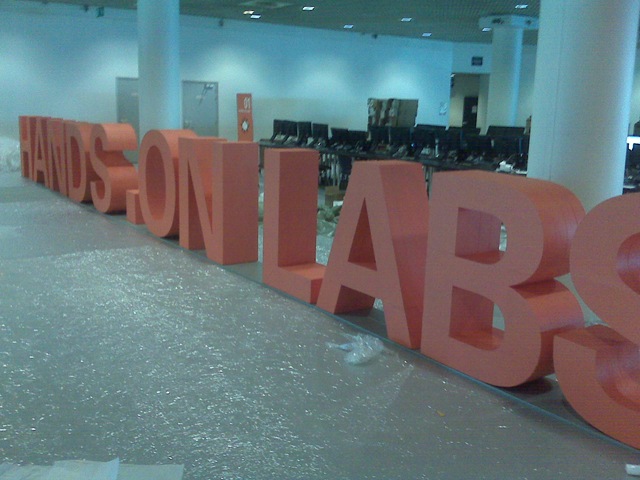
Here are some pictures from the Solutions Exchange as it’s being setup

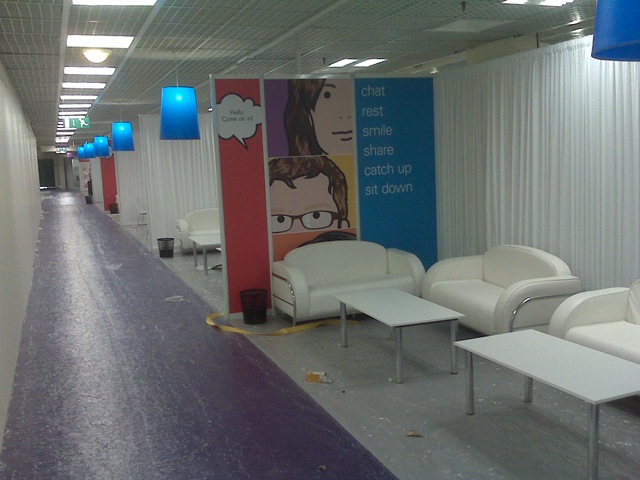
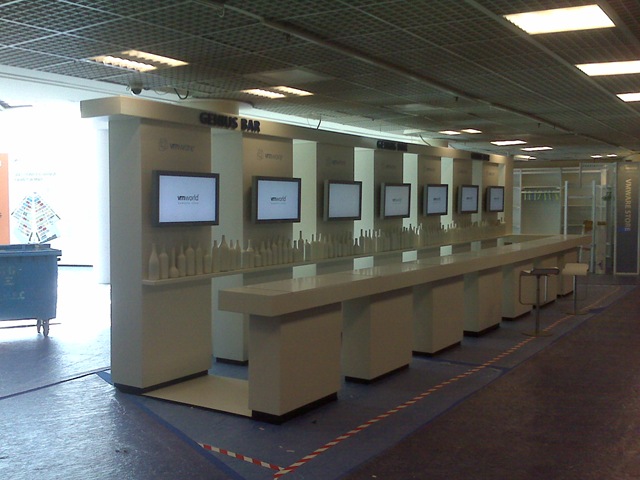
Right, early start tomorrow (or later today, it’s 1am local time)… more live posts from the keynote – here’s hoping for some major product announcements from VMware to counter the recent MS/Citrix ones.

 Virtualization, Cloud, Infrastructure and all that stuff in-between