Virtualization, Cloud, Infrastructure and all that stuff in-between
My ramblings on the stuff that holds it all together
Monthly Archives: May 2010
Matching an HP FlexNIC in ESXi to Chassis Flex10 Bay and Port Number at Install Time.
Posted by on May 28, 2010
When you are setting up an HP blade with ESXi you’ll want to ensure the administration interface is setup on the correct FlexNICs so you can add it to vCenter and continue the configuration – this can be confusing as there can be a large number of NICs presented. Up to 4 per Flex10 module, and in this case we have 2 Flex10 modules in the chassis, giving a maximum of 8 FlexNICs per blade.
At this stage I found that the Easiest way to match up which FlexNICs you have mapped on the Virtual Connect administrator to how they show up in the ESXi (as vmnicX) is as follows;
iLo to the ESXi installation, Hit F2/Configure Management Network/Network Adapters
Compare this with the Port mapping feature via the OA (shown below) and you can map the MAC addresses for each vmnic against the FlexNIC LOM:x-y entry so it quickly becomes obvious which is which.
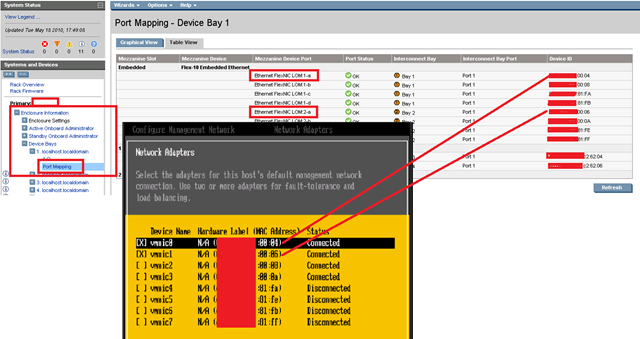
You can also look in the server profile assigned to the blade if you need more information about which VLAN a FlexNIC maps to.

HP Blade iLo and Internet Explorer 8 Problems
Posted by on May 26, 2010
Whilst HP kit is still very good and despite the disappointing iLo performance I have noticed a further annoyance, there seem to be a number of incompatibilities between the HP Blade iLo’s, blade chassis virtual connect modules and Internet Explorer 8, they all work ok on IE7, so hopefully an update will be coming soon
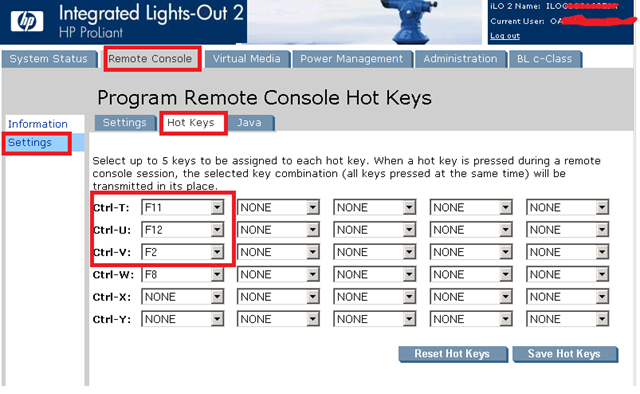
Blade iLo – if you need to use the Fxx keys like F2 to configure an ESXi host or F12 to shutdown it doesn’t map into the iLo session but either doesn’t work or is trapped by the local IE8 browser – you can work around this by going into the iLo web-administration page and mapping hot-keys manually for now.

However, the mouse-over/help items don’t work at all in Virtual Connect Manager with IE8, works fine on IE7; not a major issue but it is a bit of a pain.

I noticed all of this on the following OA hardware/firmware revisions – hopefully there will be an update soon

BL460c G6 iLo

So for now I would suggest using IE7 wherever possible, if you need to update your firmware then this link is useful and I have this page with general HP c-class and EVA information
Want to see the Uber vT.A.R.D.I.S at VMworld?
Posted by on May 25, 2010
This year VMware have changed the way they are planning the VMworld sessions, this year there is a list of sessions that are open to a public vote, Mark has a great post on the selection process here – I think it’s a great way to get the most wanted content at the event.
I submitted a session around my work with solid state storage for VMs and my popular vT.A.R.D.I.S lab environment which I’m happy to see has been opened up to public voting,
If you would like to see some live no-safety-net demos of the Uber vT.A.R.D.I.S (20 node virtual ESX clusters, 120 running nested virtual machines on 2 cheap physical boxes with replicating virtual SAN, and virtual layer 3 networking!) then feel free to vote 🙂
You can vote at this page (you’ll need a VMworld.com account which you can get here) I have submitted two sessions.

Details of my proposed sessions are;
Technology and Architecture
Title: Building a low-cost home lab, the virtual way
Session Id:TA6980
Abstract:
Ever wondered how you can run all that enterprise-scale goodness in your house in a way that others won’t complain about it? Then you need this session. Learn about how to use VMware vSphere and open source tech to build a lab with shared storage, layer 3 networking, replicating SANs and as many virtual hypervisors as you need for less than $1k USD. Want to build a 20 node ESXi cluster on 2 physical boxes? Or test out VDI scenarios, scripts and provisioning processes? Attend this session to find out how!
Type: Breakout Session
Track: Technology and Architecture
Speaker Detail: Speaker: Simon Gallagher

My second proposed session is around using consumer solid-state storage with some clever software to build highly performant solid-state virtual SANs, based around my work with the FusionIO cards, RAM disks and other consumer-grade SSD
Technology and Architecture
Title: Spinning disks are sooo 1970s – solid state is the future people!
Session Id: TA6981
Abstract:
“This is the future people, spinning disks are power hungry, slow and sooo 1970. It’s not just for enterprise-grade IT, see how to use software based vSAN, NAS and iSCSI technology to leverage consumer-grade solid-state DAS as shared cluster storage – use software features to creare your own low cost storage tiering and even replication. See live demonstrations of running virtual workloads from consumer-grade cost solid state storage; Including FusionIO, HP Lefthand VSA, OpenFiler”
Type: Breakout Session
Track: Technology and Architecture
Speaker Detail: Speaker: Simon Gallagher Company: vInf
It would be great to have the opportunity to take a bigger and better vT.A.R.D.I.S out on tour again and all of the proposed sessions in the various tracks look great, there are several that I look forward to seeing.
Maybe just vote to laugh at me trying to explain why I need all that kit whilst trying to get through airport security 🙂
HP Blade iLo – it’s 2010 and disappointingly still using a 100Mb NIC?
Posted by on May 20, 2010
I wrote this original post over 2 years ago when I first had to build a set of HP blades in a c7000 chassis, having just taken delivery of another c7000 I had hoped that technology in the onboard administrator (OA) modules had progressed a bit further than it has.
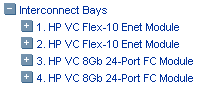
For some reason they still only have 100Mb/s on board NICs, despite all other parts of this chassis using the all-singing and dancing Flex10 10Gb technology.
iLo/OA NIC Settings

Blade Chassis Interconnect Bays – high speed goodness
Whilst I realise PXE and Altiris etc. are the preferred method for building out large numbers of blades, it doesn’t work for everyone and particularly when it’s the 1st chassis in a Greenfield environment you need to get an OS on a blade before you can even start to setup a PXE server – Windows 2003 over iLo takes about 4 hours to install, 2008 is even worse – or have someone use a USB attached CD to install the 1st blade an OS physically in the DC.
I accept that the iLo is for out of band, emergency type access where the blade OS isn’t accessible – but in my experience there are a large number of scenarios where you need to use tools that boot from DVD/CD .ISO images in a hurry like data recovery, forensic analysis, bare-metal OS restore tools, P2V tools etc. and 100Mb/s just doesn’t cut it these days.
Also if you work in a secured environment then getting clearance to run great and useful tools like DHCP/PXE on networks that could be routed to/from outside the DC is hard, sometimes virtual .ISO media over an isolated and secured OoB network or a person on-site in the DC with physical media is the only acceptable method for moving data.
Gigabit networking is such a ubiquitous technology these days, and with the OA modules for a blade chassis costing around £1k GBP each (2 generally required for redundancy) you would think there is enough budget to go for Gigabit on-board and make the excellent virtual media features really usable in all scenarios

On the plus-side, they have a fancy new BIOS splash screen 🙂

…or is it just me?
Windows 7 Remote Desktop Client – Nice Touch
Posted by on May 19, 2010
You can download and install the new, updated RDC 7.0 client for free for any OS from Windows XP SP3 and later (it ships with Windows 7) known issues here and detailed feature comparison per OS here and downloads for various client OS’es are below
Update for Windows Vista, x86-based versions
 Download the Update for Windows Vista for x86-based systems package now.
Update for Windows Vista, x64-based versions
Download the Update for Windows Vista for x64-based systems package now.
Update for Windows XP, x86-based versions
Download the Update for Windows XP for x86-based systems package now.
A nice touch that i discovered by accident is that you can move the top title bar along the top of a full-screen RDP session by clicking and dragging, this is really handy if you work on multiple full screen RDP sessions inside another RDP session – for example a jump-off box to a protected subnet or when you have a full-screen application.


AkA Terminal Services client, Remote Desktop Protocol Client, RDS Client, Remote Desktop Client, RDC, RDP, RDS 🙂
Enjoy
The End of Spinvox
Posted by on May 18, 2010
I have been using SpinVox’s voicemail to email/text service for nearly 2 years and it’s been really useful to my daily workflow as I can tag/flag emailed voicemails to ensure they are dealt with. I just abruptly got a text saying the service will be finishing in 7 days.
Dear customer, we regret to inform you that SpinVox is no longer supporting free accounts and your service will expire in the next several days. For other options, please visit www.spinvox.com or call your mobile network provider should you wish to re-enable standard voicemail service. We thank you for your support and apologize for any inconvenience
Whilst the quality of translations has definitely declined over the last year; this seems to have been an unfortunate part of their aggressive translation off-shoring strategy – talk of “the brain”, the much feted automated translation engine seems to have been mostly wishful thinking.
Shame, I will have to try and find something else now… but I’m pretty sure they used to reverse SMS bill be £5/month!
It seems Spinvox’s technology has been merged into a telco-only service from Nuance, so you can’t directly subscribe to it.
More details for existing subscribers here – when it finishes you will need to reset your voicemail settings, as it won’t happen automatically
When the SpinVox voicemail-to-text service expires does my phone automatically return to voicemail mode?
No. Users will need to remove their mobile phone’s divert settings to the SpinVox voicemail-to-text service or update the divert number to their new voicemail, as appropriate for the user’s voicemail plan.
In the UK, you can reactivate standard voicemail by entering the following code and pressing call:
Vodafone: 1211
O2: 1750
All others: ##004#
Bloggers, keep an eye on your RSS feed validity
Posted by on May 15, 2010
I had an issue recently where my RSS feeds were not being picked up correctly by the PlanetV12n aggregator, I have never really had any problems in the past but as of a post last week it stopped passing through the article title to the PlanetV12n and thus it’s twitter feed(s).
I had not made any changes recently other than publishing content but I guess somewhere down the line between my blog and feedburner more strict validation settings had been turned on – had I not spotted the problem via twitter it would probably have continued without my knowledge.
If you are a Feedburner customer I would recommend checking out and subscribing to the FeedMedic and FeedBulletin features which will alert you straight away to any problems in processing your feed, if like me you no longer have much time in your daily workflow to work through your RSS feeds you may be interested in http://www.feedmyinbox.com which is a free online service that emails contents of RSS feeds to your email address (which in my case doubles to my mobile phone) – you can point this as the unique URL of your FeedBulletin service to be alerted to any problems via email as soon as they are picked up.
You can also manually check the validity with this online tool FeedValidator.org
As an aside, I was pleased to see that several hundred people subscribe to my FeedBurner RSS feed, as it’s a while since I last checked and apologies for the interruption to service.
normal service should now be resumed (hopefully)…
How to Reset ILOM password on a Sun x4200 Server
Posted by on May 15, 2010
Power down and disconnect the server, open up the server, place a jumper over Jumper P4 (different models like the M2 use different ports) but P4 is on a block of 3 2-pin jumpers on the right-hand side near the power supplies.
Power up the server and wait for the OS to boot (important), login via the serial console connection; the user/password will now be root/changeme
Reset the password via the web GUI and power down the server
remove the jumper and it will work using the password you set; if you forget to remove the jumper it will always default the password to changeme
As a bonus you can change the IP address via the serial console whilst it’s defaulted
login using root/changeme
cd /SYS/network
show (will display the current config)
set pendingipaddress=1.1.1.1 (or whatever you need)
set pendingipgateway=1.1.1.1 (or whatever you need)
set commitpending=true
and after a minute or so the IP address will be set and should be accessible over the network
The full service manual is online here
Don’t forget to remove the P4 jumper, if you can’t find a jumper as they are quite rare these days – look for an old HP or Compaq server, that’s what I did 🙂
HP ML115 G5 Cheap Lab Servers going, going, going…
Posted by on May 13, 2010
Just got this from ServersPlus – if you are thinking of building your own vTARDIS I would suggest you get in quick, I would assume the newer G6’es are coming but seem to be much more expensive and less ESX compatible based on Techhead’s view of the ML110 G6
Good morning,
I just wanted to let you know the latest info on the ever popular HP ML115 tower server which has landed back in stock with us today. The product has now been announced as end of life and will no longer be available after this last batch which HP have produced.
As a result, HP have also increased the cost price on the final shipments meaning that the lowest price we can offer them at is £249.95. Whilst I appreciate that this is quite a jump from the previous price, it is still by far the cheapest tower server available for its specification, and we still expect the final units to sell through quickly.
HP have announced that the ML115 will be replaced but cannot confirm any specs, prices or ETAs at this stage. Therefore, if you are interested in securing any of the last of the current model, I’d ask you to get in touch so that I can put them aside for you.Regards
Ben Voce
Senior Account Manager
Direct:
01977 739 014Email:
ben.voce@serversplus.comWeb:
www.serversplus.com
Get them whilst they are hot!
ACADIA…thoughts
Posted by on May 10, 2010
Now that the VCE joint coalition has announced their new CEO they launched the acadia.com website with a blog.
The Acadia proposition is interesting as a joint approach to delivering private cloud infrastructure – this sort of pre-packaged solutions offering with good vendor support is a welcome addition to the industry, but other than tighter links to the product vendors I’m not sure what more they bring to the table over a traditional VAR.
As an aside, I worked on a very similar concept in 2008 for my current employer, although on a much smaller scale – we built a repeatable private cloud stack around a set of well-understood technologies.
I have deployed it a number of times and as a professional services organisation I have seen 1st hand how this base template approach has helped accelerate not only the pre-sales and design process but also the delivery of actual infrastructure to the end-customer – particularly when working to build infrastructure for a new solution where current metrics and sizing information just isn’t available.
You can read my original thoughts about my work on a private cloud platform here – I do however think the VCE coalition has some way to go yet around it’s software licensing before it’s really workable on a true ‘pay as you go’ basis – rather than bundling everything up into a traditional commercial lease-purchase type agreement for hardware and software.
I also have yet to see some more innovative commercial models for the procurement of the infrastructure itself – although the vBlock is designed to scale in a horizontal, modular fashion if you need to scale down how do you do that? the cost is “sunk” with the vendor/reseller and I can’t see them wanting to undo that traditional commercial model.
I’ve seen IBM start to pioneer some mainframe pay as you go type commercial models down into the x86 space, where they ship you a fully loaded system and you pay for capacity that you use – this kind of works for vendors as they don’t have to pay margin to resellers and distribution if they can do it direct and it comes from their own factories at “cost” prices, a traditional VAR would find that this carries a significant financial risk so would usually seek to offset this via a contracted capacity and guaranteed capacity expansion.
I wonder if this could be a key selling tool of the ACADIA proposition – at a guess I’d say EMC/VMware/Cisco still want to sell tin/software as a capital item and get it out of their warehouses and bank the outright sale but they have a stake in the ACADIA business, they are the shareholder(s).
What if the ACADIA business were able to act as a financial intermediary – buying kit (hardware or software) from the VCE partners, levering volume and special pricing via its owners, handling logistics and leasing infrastructure out to the end-customer with professional services, rather than relying 100% on sales margin and professional/managed services revenue.
In theory ACADIA could build a diverse enough pool of customers that it could weather storms in any specific market sector (financials, telco, media etc.) to keep an overall positive profit and market performance. Because the “product” is built around a standard set of components (the vBlock) managing and re-distributing inventory items between customers is more feasible because it’s easier to keep “stock” of components or entire vBlocks– in this mode ACADIA could act almost as a super-VAR in traditional terms, but with some more creative financial models enabled by access to better "raw” pricing. (raw in the sense there are less middle-men and commissions to pay)
if they were able to pull this off then I can see a significant advantage over the more traditional VAR’s but do VCE risk treading on the toes of their traditional partners, distribution and resellers?

 Virtualization, Cloud, Infrastructure and all that stuff in-between