Virtualization, Cloud, Infrastructure and all that stuff in-between
My ramblings on the stuff that holds it all together
Monthly Archives: November 2010
Pushing Packets Round The M25
Posted by on November 11, 2010
Since starting at VMware I find myself driving a lot more on one of the UK’s greatest national landmarks – the M25, it’s such a delight to tourists and locals alike I really encourage you all to check it out (unless you actually want to get anywhere fast of course  ) infact if you click here you can check it out on the webcams – particular “highlights” are just before 8.30am and around 5.30pm.
it’s very much a case of this

rather than this

Although there are occasional moments of entertainment…

I can only listen to Radio 1, Capital or Kiss or even Radio 4/LBC for so long before I want to poke pencils in my ears (think I’m getting old) and my CD collection, whilst vast and conveniently encoded onto my iPod in my car offers entertainment for only so long and is tricky to navigate and stay on the road at the same time.
I’ve been a train commuter into central London for a long time rather than a car commuter and I have come to value this time (if not personal space) for reading books/websites and generally educateralizing myself (yes, I made that word up) – this is kind of tricky in the car as reading a book whilst driving is frowned upon, and to be honest my hands are already tied up with my mobile phone, coffee and … (I jest, seriously road safety is important).
So, in an effort to make more use of this “dead” time; I started investigating podcasts.
I discovered Greg Ferro’s Packetpushers (Etherealmind.com) Podcast via his blog and from bumping into him at VMworld, I’ve always known enough to be dangerous with networking stuff but this is really useful as I (and a lot of my colleagues) live in a server/software centric world, it’s so easy to forget that networking is more than just a bit of copper and some IP addresses (although let’s not forget that cuts both ways and both sides are guilty of that!); It’s really useful to get the network-side perspective of the industry at a good from the trenches technical level to expand your knowledge, plus it’s a nice change of pace from day-day work – I’ve been listening to the IPv6 stuff recently and it’s very interesting.
Other good podcasts I regularly listen to (and occasionally participate in) is the VMware communites roundtable podcast; although as Mr Troyer says himself sometimes it’s better experienced live, as the real-time chat that accompanies the dial-in show is quite entertaining.]
Check them out
vTARDIS Cloud
Posted by on November 4, 2010
Following on from my recent VMworld Europe user award I have mentioned that I’ve been working on a scaled out version of the vTARDIS, this post will act as the index for this project, there is a lot of ground to cover in terms of it’s configuration.
| Disclosure/Disclaimer – I am a VMware employee, this project is not an official VMware effort, project, fling or even a thing – it’s my private-time work, documented for the community
Very little of this is an officially supported configuration, particularly the use of nested ESX – to re-iterate, this is not a VMware supported, recommended or blessed configuration – but it works well enough for my own needs – your mileage may vary and no warranty is granted, expressly or otherwise. This is not a solution for production use, it’s suitable for lab/study work and actual performance is limited by the laws of physics If you run into difficulties with any of this please feel free to drop me a line via the comments section of this post, however I do have a full-time day job at VMware, I’ll help where I am able. |
What is vTARDIS? – see this post for details of the original vTARDIS project
What is vTARDIS.cloud?
A small, low cost physical infrastructure which is capable of supporting several multi-node ESX clusters. It provides an infrastructure representative of enterprise-grade vSphere/vCD deployments through heavy over-subscription of physical hardware as well as providing “production” home services like media streaming, data storage, DNS, DHCP etc.
Why?
My original home lab has been scaled out to support my new position at VMware and my VCDX/VCAP studies, a core part of my work is VMware vCloud Director (herein refered to as vCD) so my lab reflects that. Additionally my wife is trying to continue her IT studies, so it’s helpful to have a self-service portal for building out virtual machines for learning.
You very rarely have a large number of ESX hosts and shared storage to experiment with, testing scripts, rebuilding hosts, changing configurations. This provides a representation of a large vSphere/vCD deployment so you can carry out such work to support studies, or pre-production work.
What does it look like? – photo
The vTARDIS.cloud lives in my geek-cabin which is my home office (more info on that here) and now takes up most of a full rack.

What does it look like? – High-level architecture
the following diagram illustrates the layout of the vTARDIS.cloud
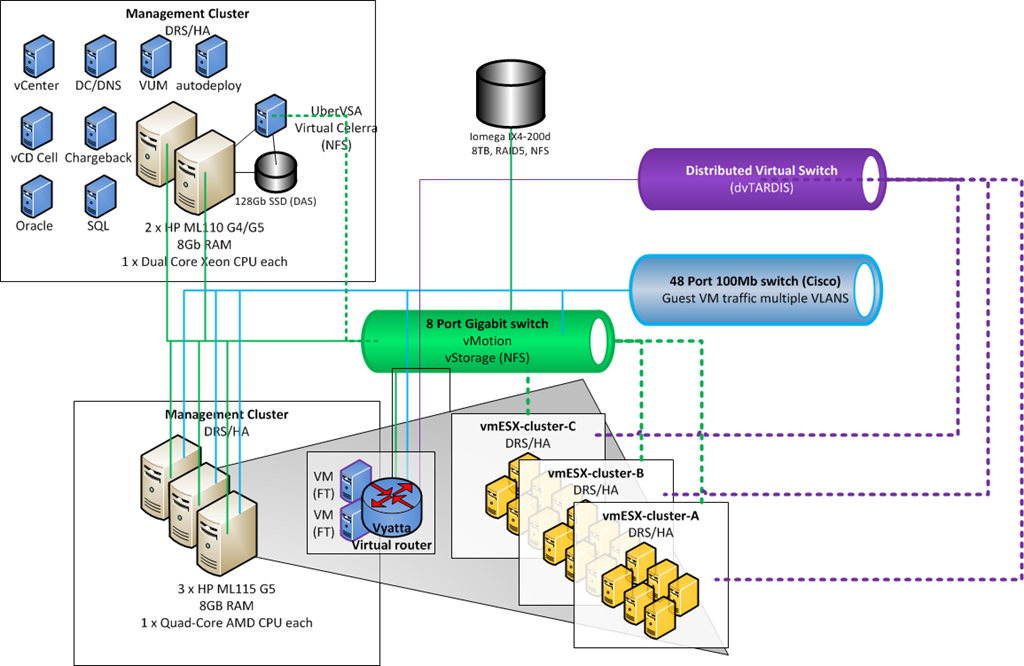
The key configurations and components of the design which I will post further details on are as follows (+more to follow);
- Stateless ESXi deployment – Using autodeploy VM to PXE boot and configure large numbers of {virtual} ESXi hosts
- Script to deploy large numbers of VMs and create DHCP reservations
- Using the Distributed Virtual Switch with nested ESX – share a single dvSwitch between physical and nested ESX hosts (complicated virtual wiring!)
- Remote Access to your home lab with a virtual appliance
- vMotion between nested VMs
- vMotion between nested ESX and physical hosts
- Configuring the Cisco 3500 XL switch with VLAN, trunk ports for ESX
- HA Layer 3 routing for the lab using Vyatta virtual appliance and FT
- Using Distributed Power Management (DPM) with your home lab
- Enabling Self-service with vCD
- Backup on a budget
How much did you spend?
I cannot say, as my wife will probably kill me  I’ve acquired most of the hardware over the years or from eBay/factory outlet stores so it’s been a gradual expansion rather than an upfront cost. But still, it’s all been out of my own pocket – there are no sponsors or generous donations of kit (if you are reading this and would like to donate some equipment, read the disclaimer at the start and if you’d still like to talk drop me a line)
| Item | Approx Cost (£GBP) | Status |
| Cisco 3500 XL 100mb switch (48 ports) | £100 (eBay) | in-use, VLAN-trunks from ESX hosts and office workstations connectivity |
| Netgear GS487T 48 port gigabit switch | £100 (eBay) | Spares (decent switch but too noisy for use in office) |
| Linksys SLM2008 8 port gigabit switch | £90 (Amazon) | vMotion/vStorage networks |
| Iomega IX4-200d 8Tb NAS in RAID5 configuration | £1,000 (online, ouch!) | in-use, critical, like it a lot but v.expensive |
| Multiple USB2 drives 500Gb-1Tb | varies | in-use plugged into IX4 for backup |
| 2 x HP ML110G4 Intel Xeon, 8Gb | £200 each | in-use (management cluster) special online deals, now defunct  |
| 3 x HP ML115 G5 AMD Quad Core, 8Gb RAM, dual port GbE Intel NIC | £2-300 for each serverwith RAM (varying deals) 80-100 for 8Gb RAM 40 for dual port Intel GbE NIC (job-lot on eBay) |
in-use (resource cluster) now EoL – hopefully they won’t die! |
| 42U Rack (no-brand) | free | holding up servers |
| 1 x HP D530 SFF Desktop PC, 4Gb RAM, 500Gb SATA | £90 (eBay) | in-reserve, was ESX 3.5 host (non x64 CPU) |
| HP TFT 15” rack mount monitor | free from skip at customer | in-use |
| HP 4 port PS/2 KVM | free from skip at customer | in-use |
| 128Gb Kingston SSD | £200 (Amazon) | UberVSA virtual SAN storage (was in original vTARDIS project; since cannibalised) |
| 64Gb Transcend SSD | £100 (Amazon – a while ago) | UberVSA virtual SAN storage |
| Compaq ML570 G1, quad Xeon CPU, 12Gb RAM, external disk array multiple 18Gb SCSI disks, SmartArray | £400 eBay (4 or 5 years ago) | retired, non-x64 and too power hungry (was power-sucken-cluster) [open to offers!] spider refuge |
| Compaq DL360 G1, single Xeon CPU, 4Gb RAM, 2 x 18Gb HDD | £500 eBay (a long time ago) | retired, non-x64 and too power hungry (was power-sucken-cluster) [open to offers!] spider refuge |
| Compaq DL320 G1 – unknown spec | free, from customer refresh a long time ago | retired and faulty, spider refuge |
| Sun Netra | free from a customer refresh a long time ago | retired, was old firewall, spider refuge |
| Compaq 2 drive DLT tape-loader | free from a customer refresh a long time ago | retired, and probably faulty by now, spider refuge |
How much does it cost to run?
This uses approx 600w of power 24/7 – it’s not that cheap here in the UK, I estimate about £6-700 per year, DPM certainly helps to reduce the power consumption of the resource cluster when it’s less-busy, although as a side-benefit the vTARDIS acts as passive heating for my garden office during the winter, that’s “green”, right?
Domestic Schedule Bliss? There’s an iPad app for that in the Cloud
Posted by on November 3, 2010
Anyone reading this that has a partner and family will probably understand my pain… My wife & I have a pretty busy schedule; work commitments and travel that are part of any modern IT consultant job, 2 young children and their highly complex schedule of social and school, nursery, classes add to that a widely distributed network of family and friends and their social events/weekend visiting and it gets pretty complex to keep track of.
As I’ve written about before my Outlook/BES Blackberry calendar is de-facto to me; I just don’t have the mental bandwidth to track everything and the bit of my brain that deals with remembering dates over a week away is either missing or faulty and multiple personal/work calendars just mess with my head.
My wife has performed a heroic task of maintaining a paper family calendar for years, but that forced me to also maintain it manually and often things were forgotten which has led to much confusion and mis-scheduling, especially when I have been away and there have been changes to my schedule.
We work in IT right? there has to be a technical solution to this pain? well yes, there is; however my wife found using a laptop or small screened mobile phone to manage a shared calendar too difficult whilst juggling 2 small children and always fell back to the paper calendar and lived with it’s limitations.
So, when an iPad was introduced and quickly adopted by everyone in the household as “good-enough” for everything from quick browsing of the web to TV guides, iPlayer, recipes, games I spotted an opportunity.
I was a bit skeptical about the iPad at first and didn’t think it would be much more than a nice toy, however it was used so much by all of the family because;
- It switched on instantly (unlike a laptop)
- the battery lasts literally forever so you don’t have to be tethered to power (unlike a laptop or iPhone)
- Has a usable sized screen that you could read things without having to scroll/pan about (unlike a smartphone); and having 2 young kids it’s wipe-clean and reasonably robust (parents will understand
 ).
).
So with some fiddling we ended up at this solution

- Google calendar acting as the central “hub” reference – accessible via a web browser from anywhere and with a good API that is used by sync applications across multiple platforms.
- My Exchange-hosted calendar is automatically synced to my fat-Outlook client and to my Blackberry via the BES.
- the Google calendar sync application runs in the background on my Blackberry and syncs with the shared Google Calendar.
- The iPad application CalenGoo syncs with the Google Calendar so the calendar can always be viewed and edited from the iPad in a convenient home-use form-factor.
- My wife’s new smartphone (which will either be a BIS Blackberry or iPhone will be able to sync with the Google calendar “hub” giving her a mobile and up to date editable copy of the calendar.
For us it works pretty well, if you have a similar problem I’d suggest you investigate it, one word of warning the BB/Gmail sync app won’t sync historical appointments from your calendar so be careful if you try to get around this with a manual import; you may end up with duplicate calendar entries (at least I did, and had to de-dupe them).
There are also Google calendar sync plug-ins for Outlook and other mail clients, but I was happy enough with doing it via my BB as that nearly always has a network connection and is kept constantly in-sync with my work calendar.
With all that sync’ing there is a latency of about an hour for changes to get replicated end-end which is more than enough for our family needs.
In terms of security my family or work schedule isn’t particularly sensitive but it’s tied down to usernames/passwords where relevant and transmission is over SSL, entries from our shared calendar get synced into my corporate calendar marked as ‘private’ – but there could be better support for a more granular model both ways here, Google calendar seems to have this concept but it doesn’t federate into into the Exchange/BB world {yet}.

 Virtualization, Cloud, Infrastructure and all that stuff in-between
