Virtualization, Cloud, Infrastructure and all that stuff in-between
My ramblings on the stuff that holds it all together
VMworld Partner Day wrap-up
Posted by on February 24, 2009
I take back what I said earlier about lack of technical track & content – whilst it wasn’t quite up to the list of previously announced sessions there was enough good stuff with information that is relevant to VMware partners with both a technical & competitive slant.
I still have my concerns that tomorrow is going to be rammed with the number of people expected, best get in early if you want a seat.


There was a fair bit of mud-slinging at Microsoft & Citrix from the ThinApp and View camp but I’ve seen similar from the other side so I think that’s just business as usual, whilst a nice thought – it would be better to have more of an independent view on the matter and I note Brian Madden has a session about VDI vs.TS and he’s always been pretty objective about that sort of thing – I’ve seen him at BriForum in the past.
Afternoon sessions were interesting, covering the upcoming AppSpeed product (‘#include <subject to change, your mileage may vary type disclaimers.h>), which is borne from the B-Hive acquisition last year – I’ve been looking forward to this as a result of early demo work I did on the B-Hive product, the upcoming vCenter integrated product is likley to support a good set of DB & Web applications as well as Exchange – I for one would like to add my vote for RDP/ICA coverage in future releases, VMware have noted this is in the pipeline for future releases, there will be a further beta programme later in the year and it looks very promising – almost a killer app for virtualization projects as far as I can tell (more information later in the week from the public sessions).
Microsoft were hosting some drinks this evening and had some interesting discussions with the AppV/HyperV guys, they have a stand in the solutions exchange and are worth checking out, IMHO if only for the AppV stuff, it’s an excellent product and IMHO better positioned for the enterprise environment and can service offline scenarios much better than VMware ThinApp (despite the mud-slinging that went on today)
 I spent a bit of time preparing the ioko stand in the vCloud pavilion, I’ll be on the stand tomorrow during the lunch break and the evening session with TechHead. Confusingly, and some would say tactically we are both called Simon in real life but if it helps, I look like this. Don’t let that put you off – or the fact that there seems to be some concrete attached to my head in the photo ! :)).
 We’ll be there with some other ioko colleagues for the welcome drinks, please feel free to come over and say hi, we have a presentation on the stand around our cloud reference architecture and customers. I would be happy to talk anyone through it and our practical experiences implementing this cloud thing (we were doing it long before it was called “cloud”).
The solutions exchange is huge.. far bigger than I had expected, drop by the Dell stand for the biggest flat-screen TV you have ever seen!
Hands-on labs are looking good – dual screen setups and thin-client devices.

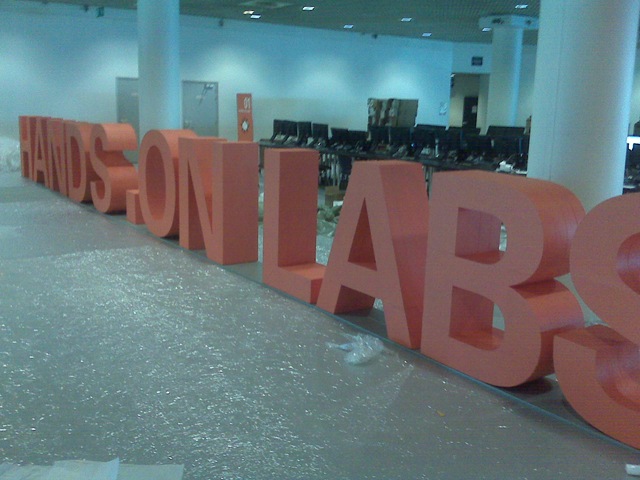
Here are some pictures from the Solutions Exchange as it’s being setup

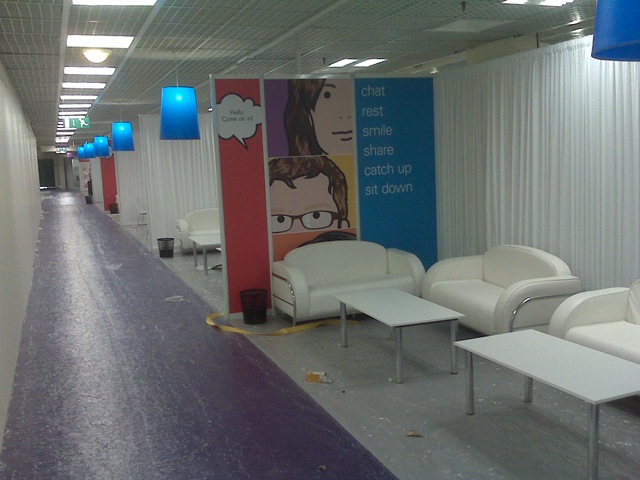
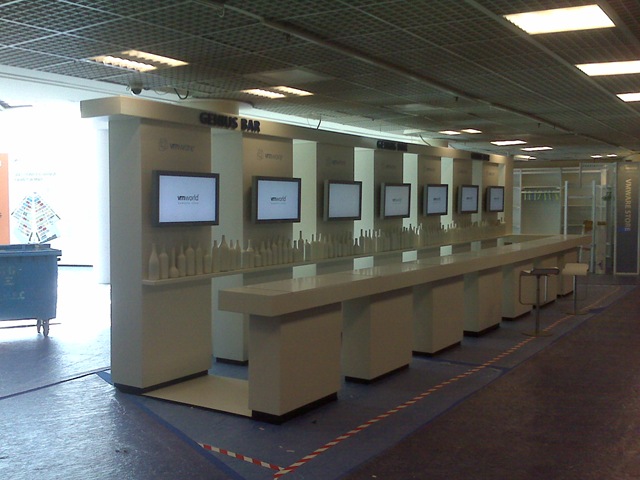
Right, early start tomorrow (or later today, it’s 1am local time)… more live posts from the keynote – here’s hoping for some major product announcements from VMware to counter the recent MS/Citrix ones.
VMworld Partner Day – Keynote
Posted by on February 23, 2009
So things have kicked off here in Cannes for VMware partners of which my employer is one, the first session is the keynote/general session – covering general product announcements, some sales woop-de-woop and details of upcoming partner programmes.

Despite the “current economic climate” (a phrase which has been used at least 100 times already today, and it’s only 11am) there VMware are still seeing a strong demand for product and services and the VMworld event itself, this isn’t surprising (to me anyway) as I’ve long seen VMware’s key message as “do more, with less” which is what you need if you are tightening the corporate belt.
There are 1500 partners here today for partner day and they are expecting 4,600 delegates for the full conference which starts tomorrow; it’s already pretty heaving on the 1st floor balcony and I think tomorrow might be pretty crammed – best try to get to sessions early.
I’m not sure what happened but when I signed up for partner day originally there was a full-on technical track for today, which was my main reason for attending – this seems to have vanished without a trace and the remaining sessions are a mix of sales/business/competitive and partner sessions with what look to be some high-level tech session later today – this is a bit disappointing and I’ve not seen anything in the run up to say this was going to be the case, ah well I’m sure there will be some useful information anyway.
There was some interesting positioning of virtualization which I’ve not seen spelled out before – positioning it as enabling the “software mainframe”, building a large, reliable compute resource but using industry standard building blocks, reducing proprietaryness (new word I have invented) like you have with traditional mainframes (ICL, IBM, etc.) through standardisation of constituent parts (no single vendor tie-in).
in the keynote Paul outlined VMware’s key initiatives going forward;
- VDC-OS – foundation for the cloud; internal now, enabling…
- vCloud –
- Service Provider targeted,
- build clouds using VDC-OS tech
- allows eventual federation
- reduce proprietaryness (choice)
- VMware Working with standards bodies
- Desktop as a service (DaaS) – programme started with VMware View and ThinApp products, 2009 full rollout of full suite
- People stay, devices come and go
- Current model is device centric, move to user-centric (provision users not PCs.
- Abstract the underlying plumbing through virtualization
- Currently centralised / server hosted only Thin-Client/VDI
- Mobile
- Client hypervisor – make seamless replication of environment delivery and data between server based and local and sync data back
- VMware view – DaaS thin & thick clients with central mgmt.
- take advantage of de-duplication
- currently PCoIP (PC over IP – remote desktop) – blade PCs etc
- Trickle data changes back to cloud (less device dependency)
- possibly enable BYOPC (buy your own PC from say PC world, you get the choice, IT provide a sandboxed environment for you to work in
- Isolation through virtualization from local OS
- VMware would like you to install Win7 to the cloud (easy upgrades, less hardware dependencies, upgrade of lot of distributed PC hardware = resource intensive
- users & IT are Slaves to pieces of hardware.
Interesting item – Terraditchi (spelling?) is a hardware device that does WAN acceleration for remote desktop sessions they are a VMware partner and are collaborating to move the implementation entirely into software –less proprietary/dedicated hardware.
Cloud is great but as I’ve talked about before its going to take time (or will never happen) for everyone moves everything to the cloud, there will always be a hybrid internal/external cloud VMware are floating the term "virtual private cloud" through vCloud to describe a federation & choice between internal & various service providers.
this allows this sort of move to be done in an evolutionary way, rather than revolutionary (i.e throw it what you have and rebuild) – virtualization can deliver benefit now (cost saving/consolidation/DR) and position you for a strategic move to the cloud in future through the federation/standardisation from vCloud/VDC-OS.
VMware also officially using/announcing the vSphere; light on details – hope there will be a big announcement tomorrow – but he did say shipping this year.
2 (high-level) product announcements today
vCenter server heartbeat SLA monitoring and HA combined (app awareness and response time and DRS/HA)
vShield zones (leveraging vSafe API to delivery security & compliance products).
VMware are making big moves into the desktop space with the View suite and there could be a good green story here, VMware’s statistics show 684M desktop PCs in the world now
By my very quick workings are @85w each = 58 billion watts )58Million KW of energy) if a thin client + share of a central VDI datacentre is 20w that’s a huge energy saving
With the introduction of the client-side hypervisor they mention they have the possibility to solve the problems of this scenario for offline/mobile use.
Lastly, VMware Partner University is announced, accessible via Partner central All VMware technical and sales training materials online. It has been Localised to several language and is Role based (sales/pre/post) and solution specific (VI/VDI/BC)
Using VMware vCenter Converter 4 to create a Virtual Center Template
Posted by on February 20, 2009
I have a set of standard template Virtual Machines under VMware Workstation 6.5 that I use to spin up VMs, Workstation doesn’t have a native template feature but I get a VM to a point where I’m happy with the build, VM tools installed, Windows updates done etc. and then I sysprep it and shut it down.
At this point I mark it read-only and when I want to create a new Windows virtual machine I just right-click it and create a linked-clone.
This is handy for me as each VM only consumes small amounts of space as they are all just differential snapshots.
however, if I want to change the base template (for example to update from SP1 to SP2) this does present an issue as it has lots of children which depend on it so I can’t change the parent VM, in this instance I create a full clone of the base VM and update it and create further linked clones from it (essentially creating a “fork”).

I also have an ESX server farm in my lab and I like to keep my standard images consistent between workstation and ESX/VC to to save me creating and patching multiple templates.
I recently created the following templates and wanted to get a consistent copy on both my lab ESX system and my laptop VM Workstation system, I noted VMware Convertor 4.0 had been released so thought it would be an ideal time to use it to get a fresh set of images with all the current Windows updates applied.
- Windows Server 2008 x64 as a virtual centre template on my ESX farm
- Windows Server 2003 Ent, x86, SP2 as a read-only VM on VMware Workstation 6.5.
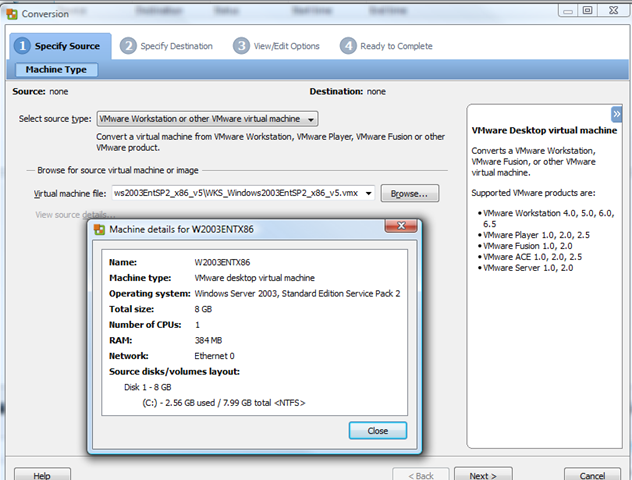
1st task is to import the Windows Server 2003 image from Workstation to ESX/VC using VM Converter 4.0;
Note the source machine options.

VM Workstation VM Information
Select appropriate target – in this instance it was an ESX farm, controlled by Virtual Center so I chose VMware Infrastructure Virtual Machine and put the hostname and credentials for my Virtual Center host, you can of course go direct to each ESX host if you don’t have VC.
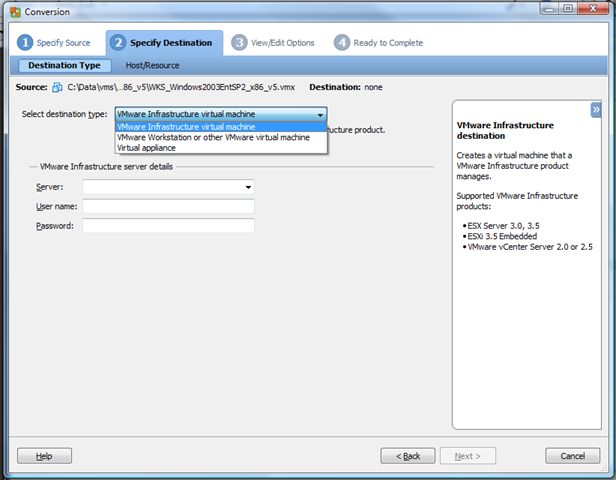
This is a new feature, you get shown all the VM’s and can choose the appropriate storage group to on each host because it queries VC

It checks it out against the host and VC 
Some better laid out options for the conversion (reminds me of the PlateSpin UI)

Options to change CPU count and SCSI controller

Options to customize service start-up options post-conversion, for example if you have an application that you don’t want to start-up until you’ve checked the target VM is ok (not applicable in this case as it’s a vanilla template, but handy to know).

These are the new sync options – and a warning that I don’t have sysprep pre-loaded in this VM – not required at this stage as the VM already has sysprep applied within (will change this once its on the target as i can apply a customization template)

Note – I chose to install VM tools, as the ESX version is likely to be different from my Workstation version that is included in the image.

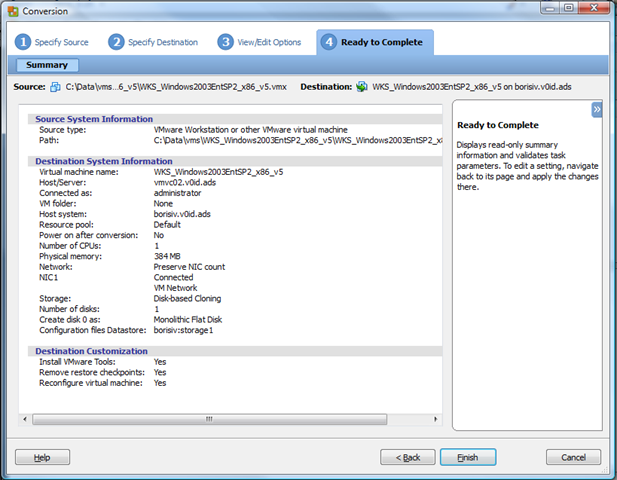
Usual summary screen… much nicer UI than previous versions
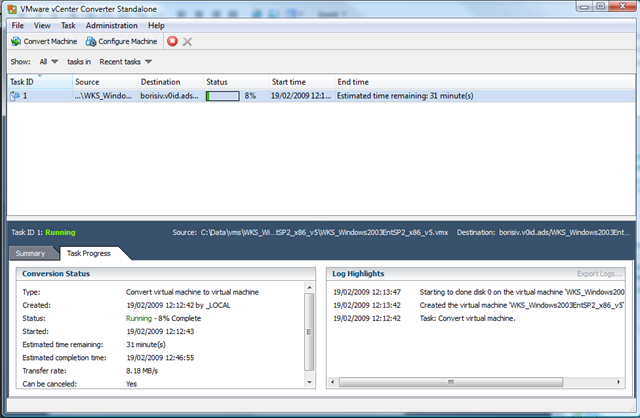
Running the conversion process, this is over a GbE network connection.
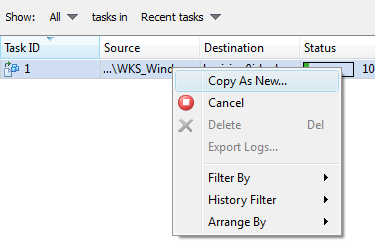
Note new job copy option.. very handy in previous versions you had to do it from scratch each time.
All done in about 20mins, although it did sit at 95% 1 minute remaining for about 10mins 🙂

And it shows up in Virtual Center as a normal VM

Worth remembering to use the ‘notes’ field in both workstation and ESX, Converter brings them across so you’ll always know this VM’s history

Now, running under ESX
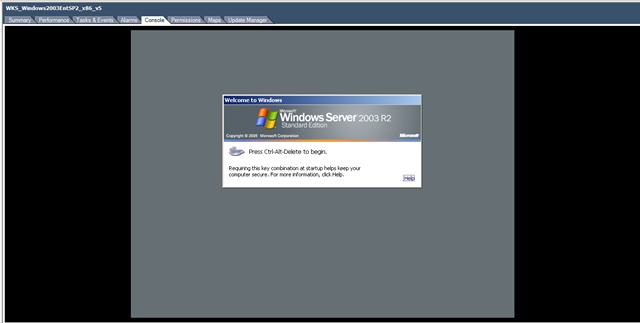
at 1st logon its detecting newly installed hardware drivers and running deploypkg.exe, which I assume converter injected to do post-conversion tasks
The auto-install of VMtools threw up some errors over unsigned drivers, so had to manually ok the dialog boxes and then it rebooted itself, wonder if I hadn’t logged on manually it may have done all this in the background automatically.
Once the VM was across I got a service failure on boot up, after I did some digging, it turns out it is something related to VMware tools the vmhgfs service failed to start due to the following error: Cannot create a file when that file already exists – I guess this is a left over from the Workstation version of VM Tools as a bit of digging revealed that this driver is related to host/guest shared networking which isn’t in ESX. – in this instance I removed the registry key relating to the driver and all was good (do this at your own risk!)

I also had a failed device in device manager, I right clicked on the VMware Replay Debugging Helper and chose uninstall and all was well, maybe I could have uninstalled/reinstalled VM Tools instead.


A reboot and all was running ok, I then shutdown the newly cleaned up VM and converted it to a Virtual Center template and was able to apply my normal customization templates (see this post for more info on that).
Next part of this article will be to convert the Windows 2008 x64 template I have in ESX into a VMware Workstation image and all my templates will be consistent.
VMworld Session Builder/Auto-Generator
Posted by on February 17, 2009
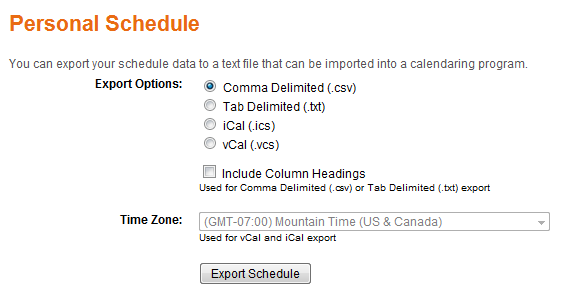
There is an automated session builder for VMworld, which lets you build up your sessions and export them into various calendar formats (Outlook, iCal etc.) I couldn’t find any navigation to this from the VMware homepage or vmworld.com site – but thanks to Virtual Aleph I managed to find a link, strange.
The link you are looking for is here, it does all seem a bit disjointed from the vmworld.com site, maybe its not meant to be released yet as Manlio says he was notified by email – but it worked for me and I have some sessions scheduled now, lots to choose from, so little time 🙂 maybe VMware will consider a 4 1/2 day format like Microsoft use for TechEd in future.
If you can’t do the auto-schedule, you may have too many sessions in your interests section, by my reckoning there are about 16 session slots; the schedule for Thursday PM hasn’t been announced as they will be re-running the most popular sessions – would expect an announcement late Weds/early Thurs on this.
Export options..
vinf.net at VMWorld Europe 2009
Posted by on February 17, 2009
Less than 1 week to go now until VMworld Europe 2009 kicks off in Cannes, I will be there blogging about the content and this is a quick post to let you know what I will be doing during this time.
“the tools”
I’ve been using twitter for a while but not extensively; I’ve found it useful during sessions to share information that later makes it into proper full-blown blog posts; IMHO twitter definitely isn’t the end of the blog but it’s useful for this sort of real-time event.
I have my Blackberry 8120 with TwitterBerry as my tweet posting client, Google maps to find my way around and it’s built-in camera/video recorder via Qik. plus the usual email etc.
My laptop; Dell Latitude D620, Windows Vista and Microsoft Live Writer (and tweetdeck) 3G and WLAN access (hoping WLAN will be good!) and the usual corporate application stack
I have remote access back to my home lab via an SSL VPN (I’ve got a big post on my refreshed lab in the pipeline) should I come across anything cool I want to try out.
I have a Mimo Flip camera as kindly provided by VMware, I’m no video wizard but I’ll try and post up anything interesting that I come across – and hopefully try not to be on camera myself 🙂
“the schedule”
I’m at Partner day on Monday – so will be posting anything of interest (subject to any NDA material)
I’ve not fleshed out my conference schedule yet; but will do so later and post it up; I note there is no pre-registration for sessions this year and they have the whole PM on Thursday reserved for re-runs of popular/oversubscribed sessions so hopefully that will work out.
There is also an interesting ancillary meeting with Microsoft around their virtualization strategy which I will be attending and will post what I can, if you have anything specific to ask the top virtualization people @MS, comment away and I’ll ask what I can.
Once I finalise my intended sessions I’ll post them up.
“the official capacity”
My rather excellent employer, ioko have a stand in the vCloud zone and I’ll be manning the stand occasionally with my colleague TechHead. Typically lunchtime and the end of the day – if you have something specific you want to talk to me about drop me a line at simon dot gallagher at ioko.com or DM me on Twitter – I’d be happy to talk you through our managed services, my professional services team and the cloud reference architecture I’ve been developing for internal and customer use.
Zeus will also be at the event and are definitely worth checking out – indeed you might want to check out this joint case study on a project we completed to provide online video for Forumula One in record time. </plug>
“the ones to watch”
My twitter account is here, if you want to get in touch, or maybe meet-up DM me and I’ll see what we can arrange.
My Blog is obviously here and I’ve added the twitter feed to the homepage and the blog RSS feed here should you wish to subscribe
My Qik account is here, I’ll cross-post Qik links to twitter
VMWare have the virtual vmworld event here – free registration
The unofficial vmworld underworld site is here
“My hopes”
I hope for the following at VMworld…
- No crazy queues, and large session halls (SF 2007 still haunts me!)
- Good, stable Wireless
- ESX4 release or public beta dates
- More tangible vCloud technical information and roadmap
- Some interesting discussions with the community
- some good free stuff 🙂
Enjoy!
How to Administer a Windows 2008 Server from a Vista Client
Posted by on February 11, 2009
This confused me for a while, up until now I’ve been using Windows 2008 inside a VM, so have had little need to remotely administer it other than via the console.
As you all know it’s better practice to use the MMC tools to admin remote servers rather than use terminal services to the actual server (uses less resources, no chance you can hit shutdown rather than logoff etc!).
In the old days you installed adminpak.msi on your XP machine and off you went, this has now been renamed to RSAT (Remote Server Administration Toolkit) – you need Vista SP1, download the appropriate update package from here.
Install the appropriate version of the update (x64 or x86) but don’t worry – you can still admin both x64 and x86 servers from an x86 client using the same tools.
Now at this point I was a bit confused (and I hadn’t read the KB article in full…tsk) but there were no handy admin tools in my start menu anywhere.
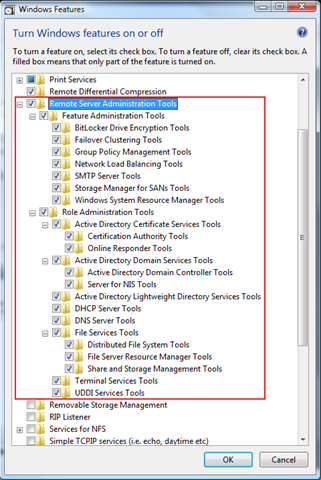
To get them installed you actually need to add a Windows “feature” via the “Programs and Features” control panel applet (I assume the update adds them there, I didn’t look beforehand).

Then scroll down and choose the appropriate tools that you need, I’ve expanded out the relevant sections and I’ve chosen to install them all.
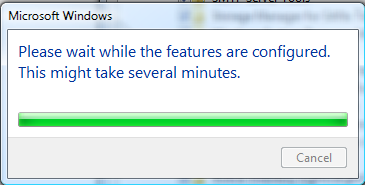
Waiting…(no need to provide any CD’s or anything as Windows Vista has the whole OS image on-disk in a .WIM file by default, which is handy.
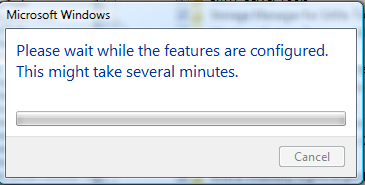
it did take several minutes 🙂
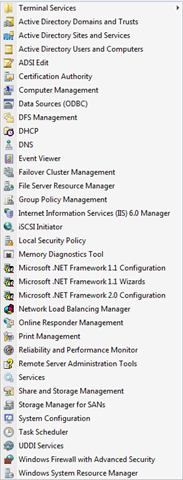
All done, and my workstation now has a full compliment of Windows 2008 admin tools
Note if you want to administer a Hyper-V server, then you need to download and enable these tools separately – details here, the link in the article is broken but you can download the appropriate update from Microsoft here.
If you run a corporate domain environment, its probably worth bundling these into a GPO or SMS installed package for your administrative machines, as it takes a little while to do by hand (as I did) and you have to jump through the WGA hoops to get the downloads from Microsoft.
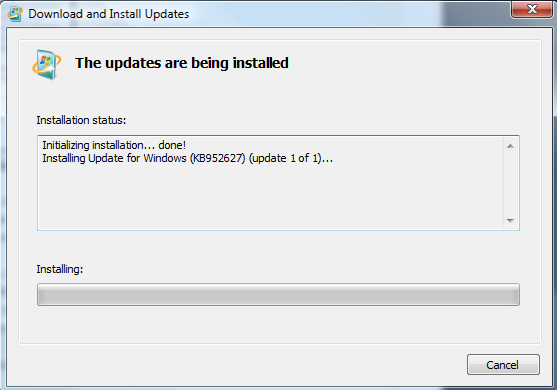
Hyper-V Management Tools install (Vista x86 SP1)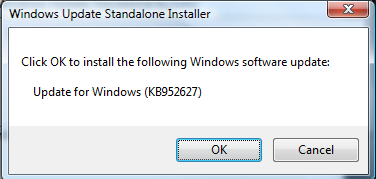
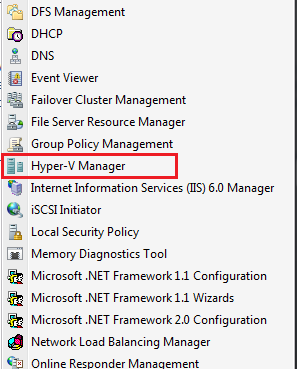
On the subject of Hyper-V – there is an article about a beta version of a solution accelerator/guide to securing and hardening Hyper-V here
Cannot Set Static IP in OpenFiler When Running as a VM
Posted by on February 4, 2009
As a result of a power outage last week my home lab needed a reboot as my 2 x ESX D530 boxes didn’t have auto-power on setting set in BIOS, so I dutifully braved the snow to get to the garage and power them on manually.
However nothing came back online.. ESX started but my VMs didn’t auto-restart as it couldn’t find them.
The run up to xmas was a busy month and I had vague recollections of being in the midst of using storage vMotion to move all my VMs away from local storage to an OpenFiler VM in preparation for some testing.
However, in my rush to get things working the OpenFiler box didn’t have a static IP address set and was using DHCP (see where this is going…?)
So my domain controller/DNS/DHCP and Virtual Centre server were stored on the OpenFiler VM which my ESX box was running and accessed over iSCSI. As such when ESX started it couldn’t locate the iSCSI volume hosting the VM and couldn’t start anything.
 OpenFiler couldn’t start its web admin GUI if it couldn’t get an IP address, nor would it mount the shared volumes.
Once I’d figured out what was going on, it was simple enough to get things going again;
- Temporary DHCP scope on my router,
- IPCONFIG/ RENEW to get a temporary DHCP address on my laptop
- VI client directly to ESX box rather than VC and reboot the OpenFiler VM
- Web browser to OpenFiler appliance on temporary DHCP addresss
However at this point I would have expected to be able to set a static IP address and resolve the issue for the future, however I couldn’t see any NICs in the OpenFiler config screen (see screenshot below)

I thought this was a bit odd, and maybe I was looking in the wrong part of the UI, but sure enough it was the correct place.
I tried updating it to the most recent software releases via the handy system update feature, which completed ok (no reboot required – beat that Windows Storage Server! :)) but still no NICs showing up, even after a couple of reboots to be absolutely sure.

Then, I stumbled across this thread and it seems this may be a bug (tracker here) following Jason’s suggestion I used the nano text editor via the VI remote console to edit the /opt/openfiler/var/www/includes/network.inc file on the OpenFiler VM as follows;
Before:

After:

I then refreshed the system tab in my browser session and the NICs show up;
note as part of my initial troubleshooting I added a 2nd virtual NIC to the VM, but the principal should apply regardless.

And I can now set a static IP etc.


I had to reboot my ESX host to get all my VM’s back from being inaccessible, I’m sure there is a cleverer way to do that, but in my case I wanted to test that the start-up procedure worked as expected now that I’ve set a static IP and re-jigged the start-up sequence so that OpenFiler starts before any other VMs that are dependent on it for their storage.
UK Mostly Grinds to a Halt
Posted by on February 2, 2009
Lots of snow here in the UK, well 12” is lots of snow by UK standards anyway, more good travel {or lack, thereof} info here from Annie Mole
South-eastern Railway’s website has ground to a halt (not exactly unusual, even on a good day!).
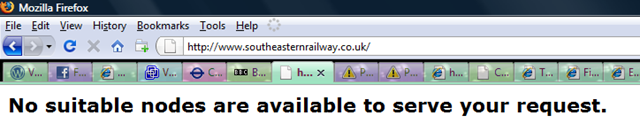
For me out here in Kent, all of my local train services are all suspended, as are the buses and at least the BBC website is a bit more reliable.
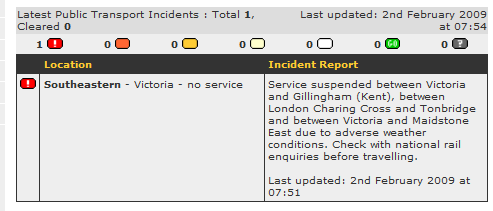
All of the roads are blocked or have delays so serious as to not make it worth anyone’s while to attempt it.
My daughter’s nursery is permanently engaged on the phone so I’m suspecting that means closed – they definitely need a better push based notification/alerting system – maybe I’ll suggest I write one for them!
Welcome to 2009 :), thank goodness for technology – all of my planned meetings are now conference calls, email/IM keep the lines of communication open and the web means I’m a better informed traveller so I can make an informed decision before attempting anything.
Even 10 years ago when I can last remember this happening down south things were pretty different, the tech hasn’t changed that significantly but what has changed is the adoption and acceptance, broadband penetration and general acceptance that previously “frivolous” activities like IM the web and email are actually critical business tools these days, particularly when conditions mean it’s less efficient to get about and do things face-face.
Could Skynet be a Cloud Application, and Should I be Scared?
Posted by on January 29, 2009
Has the cloud been sent from the future to kill you?
It’s Friday… so time for something completely different, Smugmug have already built skynet here on EC2 which decided it wanted more power… and made a semi-autonomous decision to scale itself out to mammoth proportions, if you weren’t as diligent as they are and maybe don’t pay close attention maybe your EC2 bills would bankrupt you by the time you see the invoice, assuming no credit-control limit… then you’d be out on the street, maybe loose your job, etc.
Or what if your EC2 instances picked up some kind of malware that is EC2 aware and it suddenly started to become a botnet, harvesting people’s credit card details to open up new EC2 accounts and spawn more parallel instances of itself, or spread to other cloud providers or opened up online loans, credit cards and gambling accounts, trade accounts, share dealing accounts – which in turn bankrupted other people. what if it made a coordinated (or maliciously intended), distributed on-line run on a particular stock, sparking panic buying, which in turn causes credit crunch 2.0 and brought about the end of humanity? oh, wait… that’s going on now.. maybe we know what caused it 🙂
What then if EC2 did provide IP connectivity back to your own networks and it started stealing and disseminating your internal commercial data (or entire virtual servers..), what if you ignore all that security best-practice stuff and start plugging in your office HVAC system into the LAN (lots of it going on these days) and it decides that it should brute-force access into or DoS your building UPS, resulting in overloads and fires.
Maybe virtualization is that chip they found, and VMware are really Cyberdyne systems?
Ok, bit off the wall but this thought came to me on the train home today…I’ve had a nasty dose of the flu, so maybe that paracetemol was a bit stronger than it said on the box 🙂
Best to remember those firewalls, sandboxes and policies are there for a reason.. and people’s natural impatience to embrace new things can always compromise that, especially in today’s world of instant/on-demand gratification… why do I have to wait 7 days to sign my paper! credit card application form… those check-points are there for a reason, the same security principals that apply to the physical world also apply to the cloud and virtualization – just because you can do something, doesn’t mean it’s the right thing to do, you need to assess risk and mitigate accordingly*
Normal service will be resumed shortly..
*Although I would expect there would be a few eyebrows raised if your corporate risk register contained an essay on how to mitigate against a horde of cyborgs controlled by your HR department trying to exterminate you (oh, wait..:))
Microsoft Virtualization User Group Meeting (UK)
Posted by on January 29, 2009
I’ll be attending this user group event this evening in London; if you’re local and interested then I believe it’s never too late to register.
If you’re not local then you can view the webcast (details below) online
Looks to be some interesting content, and always good to speak to customers who have done it in real-life, the Microsoft virtualization user group UK site is here
Next In-Person Meeting
Microsoft Virtualisation User Group – January 2009 Meeting
Location:
Microsoft London (Cardinal Place)
http://download.microsoft.com/documents/uk/about/downloads/victoria_map.pdf
Date & Time:
Thursday 29th January 2009
18:00 – 21:30
Agenda:
18:00 – 18:15
Arrivals
18:15 – 18:45
Simon Cleland (Unisys) & Colin Power (Slough Borough Council)
Case study: Hyper-V RDP deployment at Slough Borough Council
18:45 – 19:30
Aaron Parker (TFL)
Application virtualisation – what is App-V?
Benefits of App-V & a look inside an enterprise implementation
19:30 – 20:00
Food
20:00 – 21:15
Justin Zarb (Microsoft)
Application virtualisation – in-depth look at App-V architecture
21:15 – 21:30
Q/A and wrap up
Registrations:
Register at the forums for this event here
Or email meeting@mvug.co.uk
Live Meeting:
Click Here
No need for a meeting ID
Room opens at 5.30pm – meeting at 6.30pm

 Virtualization, Cloud, Infrastructure and all that stuff in-between