Virtualization, Cloud, Infrastructure and all that stuff in-between
My ramblings on the stuff that holds it all together
HP Installable build of ESXi 4.0 Update 1 PSOD on an HP ML115 G5
Posted by on February 19, 2010
If you have a supported HP server and you need to install ESXi either on a flash drive or a local HDD you should really download the HP-specific build from this link, rather than the one you would download from vmware.com as it includes all the HP CIM providers to allow hardware monitoring – you don’t get those out of the box from VMware.
However, the ML115G5 that I have in my lab isn’t technically on the HP HCL for ESX4 however it works perfectly with ESX4 classic and the VMware-downloaded ESX4i build (as shown here)

When I try installing the HP-specific ESXi build on it I get a PSOD shortly after boot and it’s game-over.
Techhead is aware of this problem, and has a post on a workaround for retro-fitting the CIM agents to the standard VMware build in the pipeline, so for now just use the standard ESXi build from VMware if you have an ML11x for your lab – and bear in mind this isn’t a production system – it’s a lab – think twice if you are wanting to do this for real use – it’s technically unsupported.
The Computing Super-Powers are Aligning Their Stacks
Posted by on February 18, 2010
I noted with interest the rumours today of Cisco ceasing a long-standing partner arrangement with HP (more here); essentially locking HP out of special pricing and insider product information and roadmaps.
For a long-time HP have offered Cisco components for their c-class blade chassis like the 3020 catalyst blade switch; to infrastructure people like myself this offered the best of both breeds (compute and networking) in a nicely integrated blade solution.
With HP’s recent acquisition on 3Com and their existing HP ProCurve range I would hazard a guess that they will stop selling Cisco blade switches in future – I also note from an email that all HP partners got this week that all Cisco manufactured blade switch components were facing supply issues, stoking the fires somewhat to resellers to push the HP product with some choice anti-Cisco FUD which I won’t repeat here.
 Integrated is the key point for me, if you are building infrastructure solutions you want something that has been thoroughly tested together, even if bits come from different manufacturers and follow “industry standards” you can’t beat a pre-packaged solution with proven support processes and management toolsets.
To my mind this is why Apple have always been so much more successful in the consumer space than Microsoft have; aspiration brand arguments aside, Apple have always maintained a tight grip on the end-end quality of components that go into their products (software, firmware, hardware, accessories) whereas Microsoft were born out of the opposite*;
*let’s leave aside Microsoft’s later leverage and downright abuse of closed and proprietary formats and API’s to wield their market share weight – that’s a whole different argument..
Microsoft took the x86 PC out of the grip of it’s one-vendor supplier and inventor (IBM) in the 80’s and allowed it’s software to run on a wide variety of compatible, commodity hardware, providing API’s for thousands of independent software and accessory vendors to integrate their products with DOS and latterly the Windows OS.
Contrary to what many think (Apple included) Microsoft opened up the PC market to the masses by enabling competition – allowing the consumer to choose from devices that varied in quality and thus cost to match the needs and budget of the end-user – whilst Apple maintained a steady line of expensive/premium but excellent quality products.
In the longer-term Microsoft’s image suffered as a result of this “openness” because there was less (or no) quality control of what 3rd parties produced poor quality drivers, applications and hardware entered widespread use, and all that integration often ended up in a poor end-user experience; how many times have you been frustrated trying to get product X to work on PC Y with software from Z – you are relying on 3 different vendors, each with it’s own target market and user to all do their jobs properly, and to the standards they are given to work with (Win32 API etc.)
If you are a hardware company selling an optical mouse it’s a tight margin high-volume business so you don’t have a lot to spend on quality control or good coders – you want it “done” and shipped and get the profits in – or you may just be a fly by night company that wants to rip off consumers and make a quick buck, there is nothing really stopping you.
Microsoft took steps in recent years to address the poor-quality 3rd party stuff from tarnishing the mother OS’s image through the Windows Certified logo scheme, but they never took it as far as Apple; who refuse any code that is not blessed by their own quality control on devices like the iPhone – and look how it gets almost universal praise for it’s ease of use and reliability.
The ever increasing amount of crap-ware that PCs ship with is astounding – my new HP laptop ships with about 20 different 3rd party drivers and tools out of the HP box, Hawei 3G card, AuthenTec fingerprint scanner, ATI video card with it’s own software To boot, it would seem HP weren’t too diligent about their quality control either.
Now compare that to a MacBook Pro out of the box. Apple own the end-end process – you can only (legally) run THEIR OS X on it, sure they use things like Broadcom NICs and ATI video cards but because they control the OS as well as the underlying hardware they can ensure support is baked-in when it comes out of the box, as a result their test matricies are much simpler and the end-result is a much simpler and reliable end-user experience, they also reduce the bells and whistles to what people want (how many corporate IT departments really take advantage of the smartcard or biometrics support on modern PC hardware or the SD card readers, more often than not time is spent to disable such bells and whistles in the interest of support and not overwhelming end-users).
So, after that rather lengthy into back to my point – if you want something that is good quality and just works as a vendor you need a greater control of the whole “stack” – reduce the variance of components that make up each slice of the stack and the result is;
Simpler/smaller test matrix
Quicker time to market (less variance to test)
Simpler to support – less variance
Better scale of economies
smaller supplier portfolio to manage
There seems to be a fair bit of consolidation in the market place at the moment with the bigger players announcing grand partnerships or simply making massive acquisitions.
Maybe some of the open market, where you could run Linux, Microsoft or something else on your XYZ server is being replaced with a premium/preferred “stack” from a consortium of big-name vendors.
With all the talk of cloud computing this stack has gone well beyond the desktop, office or even corporate datacentre – You can buy the stack from a vendor consortium to run on-premise and offload some your infrastructure into their IaaS/PaaS/SaaS stack – with the promise of a more joined-up approach to support and services.
In the current landscape Microsoft are in an odd position; Ballmer is pushing them all the way into the cloud stack but at the lower levels they essentially have an open partner model, I would expect to see Microsoft partner with Dell (or even acquire, as has been rumoured for a while) to come up with a “premium”/integrated product line-up; but not entirely stop their traditional OEM arrangements with other hardware vendors.
Cisco would seem to have fired the first shot in this war at HP, maybe the gloves of co-operation will come off for the rest now that people don’t necessarily have to be seen to be playing nicely in the market.
The following table shows my take on the major players and the offerings they have; I’m a realist and a lot of these are recent acquisitions or products so I don’t honestly think in all cases they really do have fully integrated end-end sales, services and support but it looks to be the goal.

Presenting at the London VMware User Group Meeting – Feb 25th
Posted by on February 18, 2010
I am pleased to announce that I’ve been asked to present again at this month’s VMware London user group meeting.
I’ll be giving a follow-up on my previous Home Lab : vT.A.R.D.I.S session for which I’ll be bringing a (quieter!) demo environment which I have dubbed vTARDIS:Nano Edition showing how you can build a complex 10 node clustered ESX environment with dvSwitch, iSCSI SAN and vMotion etc. on a single physical host for study and play.
I’ll also be presenting a case study for a project I worked on virtualizing a large Microsoft Windows 2003 Terminal Server estate and will be showing some interesting statistics that we gathered along the way.
I understand the event is now fully-booked which is a great turn out!
The agenda as as follows
1100 – 1200 (Optional) PowerCLI / Powershell workshop – Alan Renouf. Please bring your own curly brackets.
12:30 – 13:00 Arrive & Refreshments
13:00 – 13:20 Welcome & News – Alaric Davies
13:20 – 14:00 Sponsor Presentation – Chris Hammans, Pano Logic
Real world vSphere deployment experiences – Stuart Thompson
(Mostly) Zero downtime DC migration for Dummies – Jonathan Medd
15:00 – 15:20 Refreshment break
ESX home lab update, virtualizing Terminal Server workloads – Simon Gallagher
Thin provisioning and capacity planning in a virtual world – Chris Evans, ‘The Storage Architect’
Bringing the Cloud Down to Earth – Stuart Radnidge, vinternals
16:45 – 17:00 Close
17:00 – Pub
In future, to register your interest in attending, please send an email to londonvmug@yahoo.com with up to two named attendees from your organisation. If you do not receive a confirmation mail, please don’t just turn up since we will not be able to admit you to the meeting.
Content from the meetings will continue to be uploaded to www.box.net/londonug, NDA permitting.
Microsoft Tech-Days London – Free Technical Events for IT-Pro’s and Developers
Posted by on February 17, 2010
Microsoft have just announced a series of 5 “tech days” in central London, covering the following topics for IT Pro’s on W/C 12th April

Virtualization Summit – From the Desktop to the Datacentre
Office 2010 – Experience the Next Wave in Business Productivity
Windows 7 and Windows Server 2008 R2 – Deployment made easy
SQL Server 2008 R2 – The Information Platform
Looking ahead, keeping the boss happy and raising the profile of IT
It’s free to attend and although the full agenda hasn’t been released yet but I would hope they have a decent amount of technical content.
There are also similar tracks for developers.
You can read more about the ITPro days it here and the developer days here and you’ll need to register as I would think they will be booked up fast
You can also follow them on twitter for more information or with the #uktd hash-tag
Problems with HP EliteBook and built-in un2400 3G Modem
Posted by on February 11, 2010
I recently got a new laptop, an HP EliteBook 8530p; it’s quite a powerful machine and importantly for me has 8Gb of RAM and dual HDD’s which is very useful for the increasing number of VMs I have to carry around and run.

Rather usefully it comes with a built in HP un2400 3G modem behind the battery, this is a really useful feature and is better than the USB dongles you usually get as there is no chance of dropping the laptop and snapping it off or breaking the USB port.
Unfortunately I had several problems with the x64 Vista OEM build the machine was supplied with, after resuming from sleep it was unable to find the 3G modem and would stoically refuse to recognise that it had one installed or work at all after the 1st connection.
 Some posts on the web indicate this was fixed with an updated version of the HP Wireless Connection Assistant so I installed v3.5 from this page and the updated HP Connection Manager 2.0 (default build had v1.1) that seemed to sort of fix the sleep/resume problem but it still wasn’t working 100%. A forum post led me to turn off this option in the HP connection manager application, but still no joy
I wasn’t overly impressed with the quality of the drivers so went on a hunt (as you do) for newer ones.
Oddly if you look at the normal HP driver download page for this laptop it only lists a driver from June 2009 which doesn’t work, after some investigation with the HP RomPaq download tool it seems there is a newer driver on their FTP site, just it’s not listed on the web page – this driver is the most recent one version – 3.0 (details here) (sp45888 driver download here)
On 1st attempt just running the .exe it still didn’t work properly and didn’t install the driver, I had to extract the sp45888.exe file and run the C:\SWSetup\SP45888\Qualcomm\QCUSBDriver\setup.exe file rather than the setup.exe in the root of the SP45888 directory as you would normally do.
This setup app gives you a UI and lets you choose the carrier and contract type.
Once this was installed it worked ok. not the best quality control HP! – hope this post helps someone else with the same problem.


 As a side note – HP do you really need to have this many 3rd party apps, tools and drivers installed (and requiring updates) in the OEM build!?
sure there is an updater utility… but that’s a lot of build maintenance for people running lots of these machines?
Upgrading to a new PC in stages using VMware Converter
Posted by on February 8, 2010
If like me you travel around a lot and are pretty busy finding the time to get a new laptop setup with all of the data and non-standard build software you require can be a time-consuming chore.
More often than not you will be upgrading to a new more powerful machine with larger disks (unless you are unlucky :)) rather than carrying around two laptops on a trip or risking going without a particular ready to go application why not consider P2V’ing your old laptop onto your new one?
I am doing just this at the moment, I got my new laptop before I had to head out for a couple of days, VMware Converter is a free download and it took me about 3hrs with a cross-over ethernet cable this evening to P2V my old Dell laptop into a virtual machine on my new HP one. and I can now transfer my data and re-install my own applications into the host OS at my leisure; as a side advantage I instantly get the benefits of a machine with a faster CPU and better screen resolution without having to mess around with the software build or “personalisation”.
VMware Player is also free and you can use a VM in full screen mode, Player even supports Unity mode – this could be a viable long-term solution if it weren’t for the licensing position of having to maintain 2 x OS licenses (guest and host).
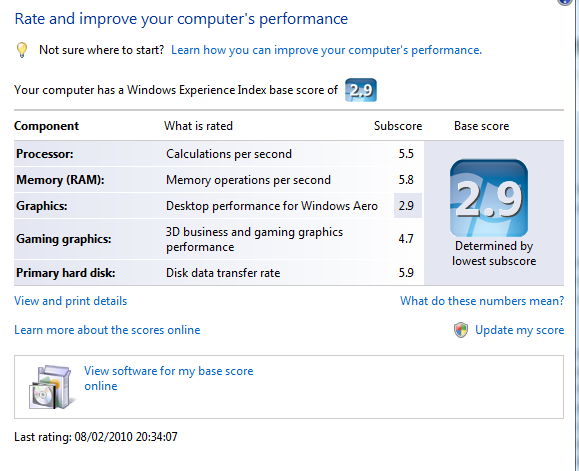
Performance is also pretty good – my VM’d laptop gets a 2.9 performance score in Vista – with the video being the lowest score.
Before (physical Dell D620, 2GHz Dual Core Intel, 4Gb, 200Gb, c.3yrs old)

After VM running under VMware Player on an HP EliteBook, 2.8GHz Dual Core Intel, 8Gb RAM, 250Gb HDD
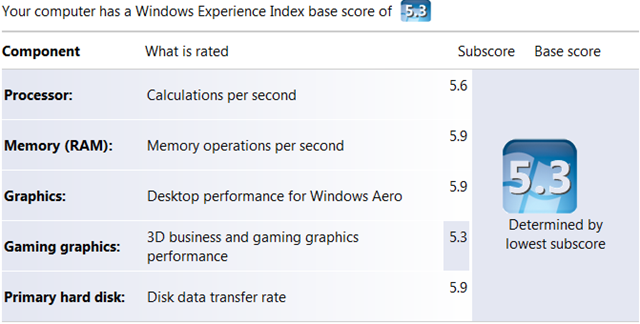
And, for comparison on the native hardware of the new HP Laptop
Keep it in mind next time you switch…
The Fantastic Tavern: London
Posted by on January 28, 2010
Bit of a diversion from the norm this evening, I attended an event called “The Fantastic Tavern” – which is a community focused series of events on a variety of creative and social-media type topics, as I normally live on the infrastructure side of bringing such concepts to life I thought it would be good to get a better feel for what’s coming and some of the thought behind it, oh yes and there was an offer of free beer and sausages…. how could I resist? 🙂

This evening’s topic was “2010 Trends – what’s hot and what’s not” and is set as a series of short 5 minute presentations by people in the creative industry – similar to the lightning talk format used at Cloudcamp. they made innovative use of a cool wall (Top Gear fans will know what I’m talking about :)) to rate the trends as hot or not through some alcohol fuelled volume based popularity measurement techniques (a.k.a shouting).
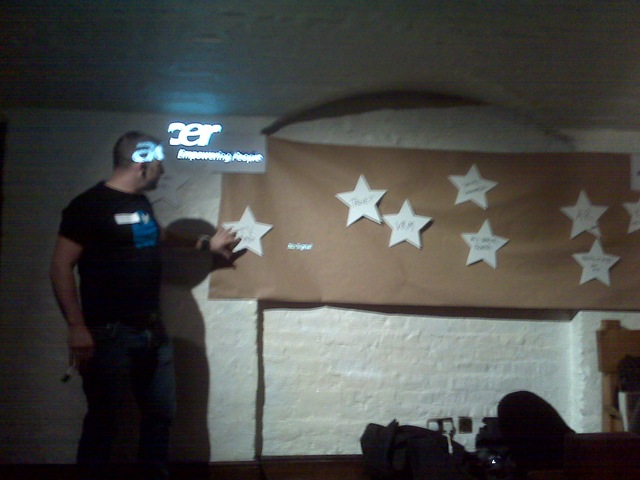
The evening was hosted by Michelle Flynn (Communities manager at EMC Consulting) and well compered by Matt Bagwell (Creative Director at EMC Consulting) these are my thoughts on the most interesting of the talks;
Augmented Reality – this is a really interesting technology to me, and he explained some the use-cases and examples of applications already available to find things like free WiFi or the nearest tube station in a visual manner – very clever stuff, I personally think this is a going to be big this year and next with the array of uber-smart phones like the iPhone and Android equipped devices with built in GPS/compass etc.
This video is a demo from one of the app makers..
Realtime – twitter, and other social networking sites have meant that information is out there very quickly for public consumption you can express your opinion brutally and loudly – this can have a big impact on brand image – poor service @your local Starbucks?, it’s all out there for people to search and read – instantly.
This can be risky – flippant, off-the-cuff remarks can have repercussions and it’s all to easy to broadcast something ill-thought out in the blink of an eye and regret it later.
Some people have used this as a great marketing hook, there was an example of a person in SF who sells Creme Brulee from a cart in the street; he has built up a massive almost cult-following by only announcing his location via twitter when we sets up, if this were “just a guy with a shop” would he have such a loyal and keen, repeat customer base? – he obviously makes creme brulee 🙂 but he has a marketing “hook”.
Behavioural Architecture this is a field of thinking being championed by Dan Lockton at Brunel university and I found it quite interesting, it’s about designing sites or services to make people want to use them, through some subtle social psychology; there was a good example of rewarding positive/healthy behaviour (like the piano stairs below) or features in facebook like the ‘like’ button and suggestions of things to do to engage further with your fb friends like completing profiles.
Playfulness – it sounds obvious but making something fun to use, encourages people use it, there was an example of Chore Wars which is an online game where you can gain a reward (points/stars/etc.) for completing chores – ideal for kids, make it a game, it’s less like work.
There was also a great example of a bottle bank turned into an arcade game
we need some of these where I live! 🙂
Truth – playing to the points of the realtime session and the concepts of citizen reporting, as an organisation it’s so easy to be caught out if you are not being truthful, you can be so visible online that any person can point out if you are being inconsistent and that can carry heavy damage. the realtime world also means we (the consumer) can be very intolerant where things don’t go our way, what customer service slights we may have previously just forgotten about and moved on from are now broadcast in CAPS and shouty !!!! to anyone that cares to listen, and more importantly it’s all there, on-record.
Transparency is becoming increasingly important and from my perspective movements like the blog with integrity programme are this in action; reputation is everything, and there was a poignant example of Tiger Wood’s recent fall from grace and the resulting fall-out
The 30-second TV ad is dead – argued the position that ad’s that are distributed online are much more likely to reach their target audience and get better engagement than the traditional linear 30-second TV advert.
I can see the logic to this, online ad’s can be made interactive and non-linear with click through and the ability to send to friends/share as this screen capture from YouTube illustrates

There was an example video shown of an interactive advert (with some naked people and strategic blue buttons that I couldn’t find online…:)) and a Toshiba advert that appears totally irrelevant to the product they were selling but got a lot of traffic.
Whilst it wasn’t explicitly mentioned this sort of model also has a much better way of measuring return on investment, you can very quickly get feedback on how well your ad is doing, click through rates, conversions to sales etc. – this is almost impossible with traditional linear TV advertising (although some of this is coming to more advanced IP-enabled STB’s)
Social Retail/Commerce – this was particularly interesting and one I have already been a consumer of; sites like Amazon make algorithmic recommendations to you, based on what you have viewed, social networks add a second dimension – social theory says that “people generally like people that like what they like” (try saying that after a few free beers !:)) recommendations from people in your “network” carry a lot of weight, and this is definitely something I have seen in the music space already.
Ratings and recommendations are also a key decision influencer, I always check out the reviews on Amazon, because they are from people (well, mostly from real people anyway).
Companies like yub.com and mflow take this a step further and offer to pay a commission on purchases that you recommend to your network (or are discovered through your network) – much like the Amazon affiliate system that I have used in the past on this blog, but extended into your social network.
His little friend Last up was Michael from Microsoft talking about the ways developments in mobile devices like pico projectors can be used to add an extra level of presence to social networking, using an example of your facebook friend being projected on a wall during a chat session from a mobile device, rather than just a normal small screen.
I had to feel for him as this is a highly visual topic but the promised internet access wasn’t available so he had to ad-lib it, but did very well.
Microsoft have some interesting demonstrations on this in Project Natal
and there was the SixthSense demonstration shown as part of the TED talks which is very cool – maybe a little bit of Minority Report in action
In the end the result was that Playfulness/Fun was voted the hottest trend for 2010, personally I disagree – I think it’s going to be social retail/commerce and augmented reality as they both have a strong potential for quick and easy monetization, with the SixthSense stuff coming to fruition around 2013/14 – no doubt I’ll be wrong, but it’s very cool.
Realtime is also a hot-topic now, but that’s so 2009 🙂
All in it was a fun evening, it’s quite refreshing that the presentations were entertaining and a lot less staid than the usual technical stuff I attend (we techies have a fair bit to learn about audience engagement during presentations), there was a liberal garnish of swearing too, which further goes to prove the truthfulness/honesty trend for 2010; if something is crap – tell it like it is and people will trust you 🙂
Next London event is likely to be in April, with an event scheduled in New York in early Feb, I highly recommend it!
Running a VM from a RAM Disk
Posted by on January 26, 2010
I posted earlier about some of my experiments with the FusionIO solid state storage card, SSD’s and the feature I spotted in Starwind to create a virtual disk from RAM – these are the quick results I see when running a Windows 2003 R2 virtual machine from a RAM disk.
This is done by creating a RAM disk on a Windows 2008 x64 machine running the StarWind vSAN software. the physical machine is an HP ML110 G5 with 8Gb of RAM.


In this test I allocated a 6Gb RAM disk on the vSAN host and shared it out via iSCSI to a vSphere 4 host running on an HP ML115 G5, where it shows up as a normal LUN and vSphere is unaware that it is actually physical RAM on a host elsewhere rather than a normal spinning disk (virtualization/abstraction :)).
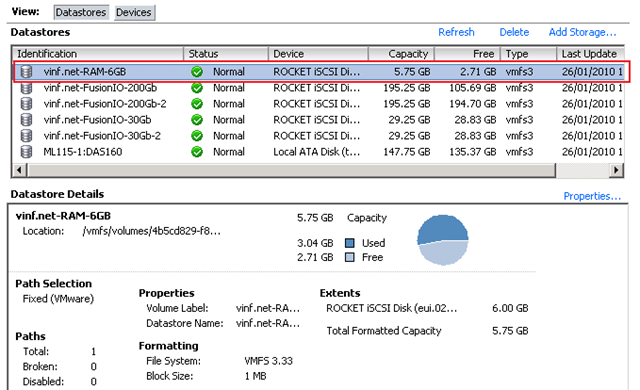
I deployed a single Windows 2003 R2 virtual machine into the 6Gb LUN via the usual processes with thin-provisioning enabled.

The topology for this test looks like the following;

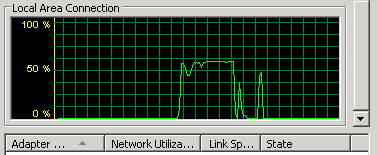
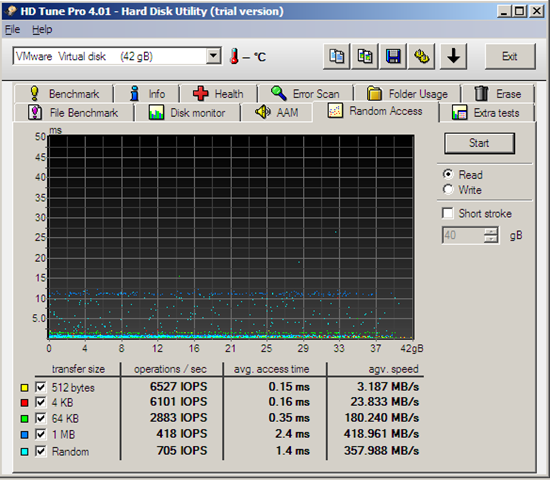
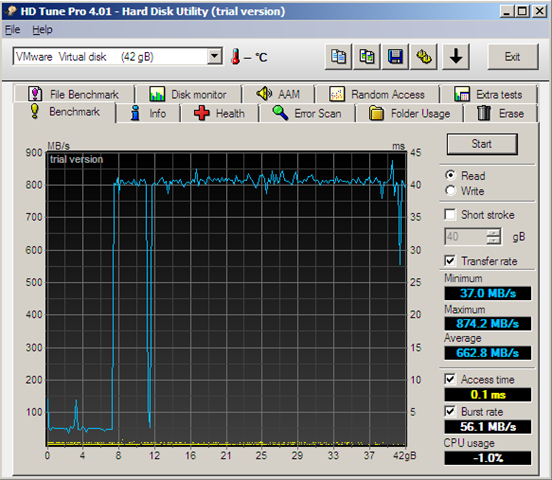
As with previous tests, and based on Eric’s work I used HD Tune Pro (trial) to get some disk access statistics; during the test the iSCSI traffic used c.50% of the bandwidth on the physical box running the Starwind software.
These are the results; which you can compare to Eric, Simon Seagrave and my FusionIO results.
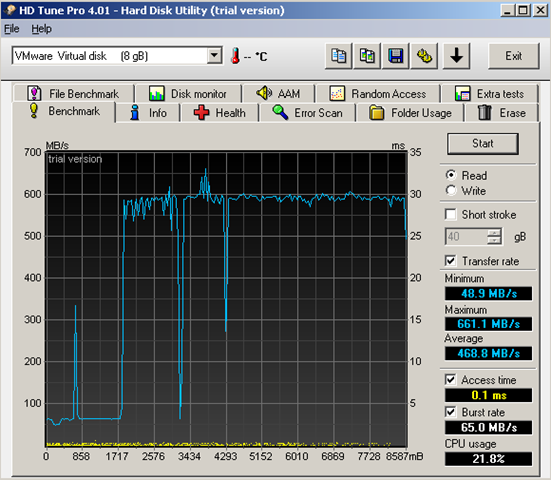

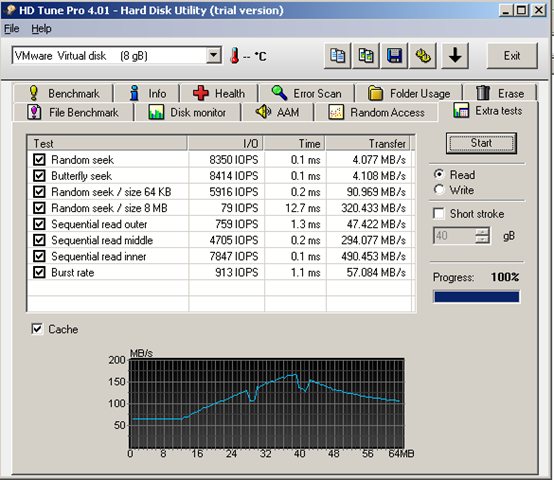
So far I have only done read speed testing, as write-testing requires some extra virtual disks – I’ll get this done in the coming weeks.
There is no escaping the fact that physical RAM is still expensive in quantities sufficient to meet the size of normal VM storage requirements. There are commercially available hardware SAN products that use this sort of concept like the RAMSAN and FusionIO but this is definitely the way the industry is going in future.
Thin-provisioning, linked-cloned and automated storage tiering (like EMC FAST) are going to be key to giving this level of performance whilst keeping costs low by minimising physical storage consumption until RAM/SSD prices reach the current spinning disk levels.
These results go to show how this software concept could be scaled up and combined with commodity Nehalem blades or servers which are capable of supporting several hundred Gb of RAM to build a bespoke high performance storage solution that is likely to cost less than a dedicated commercial solid-state SAN product.
In the real world It’s unlikely that you would want to take this bespoke approach unless you have some very specific requirements as the trade-off is that a bespoke solution is likely to have a higher ongoing complexity/management cost and is probably less reliable/supportable – I did it “just because I could”; your mileage may vary 🙂
Running VMs from a FusionIO Solid State Storage Card and Consumer-grade SSD
Posted by on January 25, 2010
Following on from Eric’s post on running VMs from SSD’s at this page, and my previous experiments at using SSD’s to run VMs I thought I would post up my initial (non-scientific) findings from the FusionIO card that I have been loaned.
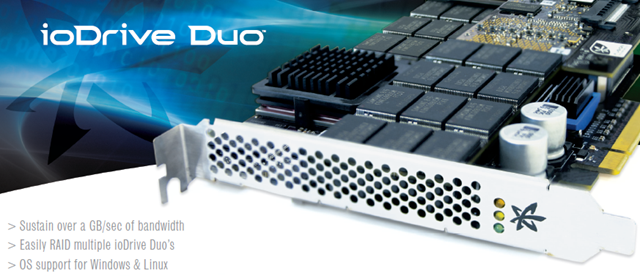
FusionIO make solid state storage cards that come packaged as PCIe x8 format expansion cards, they make use of multi-level cell (MLC) NAND storage to create amazingly high speed direct-attach storage, the Duo640 device I am working with is the mid-range offering, at the higher end forthcoming versions can support up to 1TB/sec throughput. the Woz is also their chief scientist 🙂

In my test rig I am using it and the Starwind software on Windows 2008 R2 to share the FusionIO card over iSCSI to a couple of vSphere 4 hosts – in this initial test I’m just using a single GbE NIC in both the server and the vSphere client – as you’ll see from the screenshot below it can actually max out the GbE connection in these hosts if you push it with several concurrent VM cloning sessions – so there is plenty more performance to be had out of the card and high levels of concurrency, in this case the NIC was the bottleneck.

The FusionIO duo card comes with 2 banks of 320Gb of memory (640Gb in total), in my initial configurations it’s not configured to RAID across the 2 banks, but that is possible to improve performance and fault-tolerance.
The FusionIO card doesn’t yet have drivers for vSphere but they are working on them – so you can’t directly access it from an ESX host yet so I am connecting to it using the Starwind software iSCSI target software.
One issue I found with my Starwind configuration is that the Starwind software is’t able to see the FusionIO card as raw block storage like it can with normal direct attached storage (SSD/SATA HDD etc.) although it is visible to Windows disk manager as a normal disk. so to get it to work I had to format and mount the FusionIO “disks” as NTFS drives under Windows 2008 R2 Disk Manager and create a virtual disk files in these drives using the Virtual Disk feature of the Starwind software – this is then accessible both directly to the Windows 2008 host and to my ESX hosts via iSCSI.

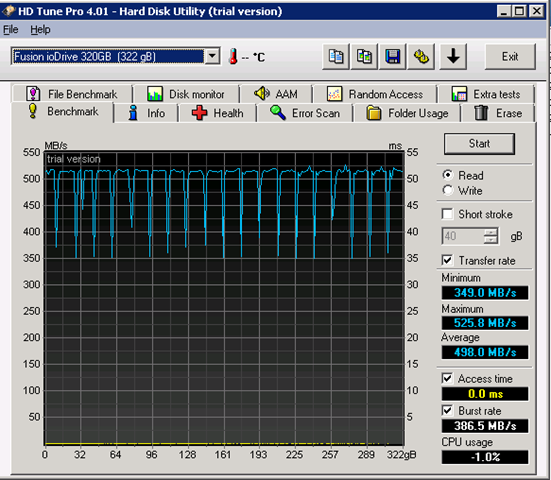
So, based on the same software that Eric used in his post these are the out of the box numbers the FusionIO card gets – there is still significant scope for fine-tuning to increase performance – But it’s pretty impressive.
FusionIO (non-RAID configuration) inside a VM over iSCSI
FusionIO (non-RAID configuration) – direct attached to a Windows 2008 R2 host

Consumer-grade SSD – direct attached to a Windows 2008 R2 host
This is using the following SSD which I purchased last year for under £200.
|
ASIN: B001BPH4Y8 |
 Trans64GB 2.5in SSD SATA MLC: Electronics & Photo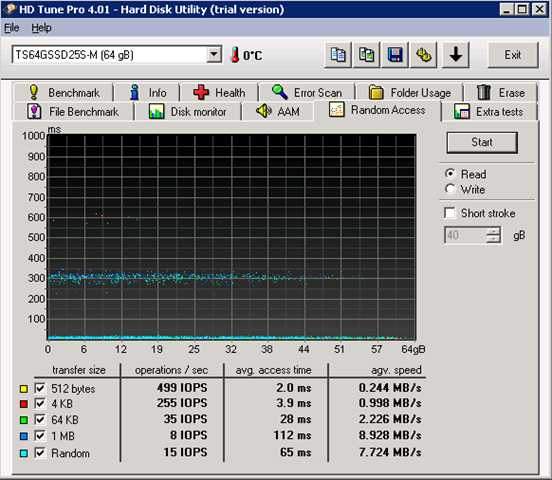
In conclusion…
The FusionIO cards aren’t cheap storage; they are in the ‘000’s of £ price-range, but they are FAST! with solid state storage pricing coming down in 2010 and when combined with iSCSI target software like Starwind it’s an excellent way to build a very high performance solid state SAN using DAS technology without the enterprise SSD SAN price-range and FC/network interconnects.
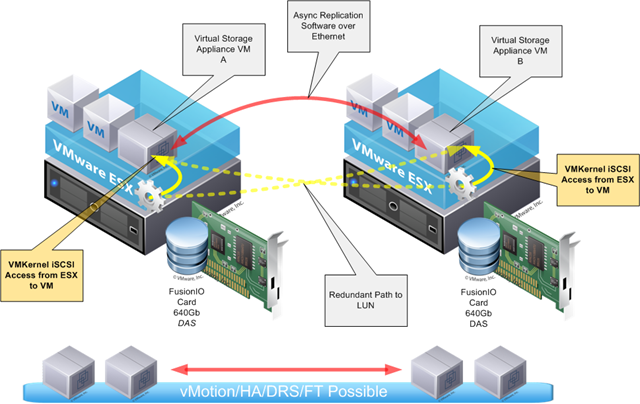
When vSphere drivers become available I can see some excellent 2-node/p2p replicating cluster/vSAN configurations using either Starwind or HP Lefthand Networks vSAN VM appliances as shown below, removing the dependency on single shared storage is a great design goal.
Disclosure: FusionIO and their UK distributor have kindly lent me a 640Gb duo card to work with, I have received no financial compensation nor have they imposed any copy approval or conditions with regards to what I write about their device – it’s just great and I’m that impressed.
Share a RAM disk via iSCSI…run VM’s from it?
Posted by on January 25, 2010
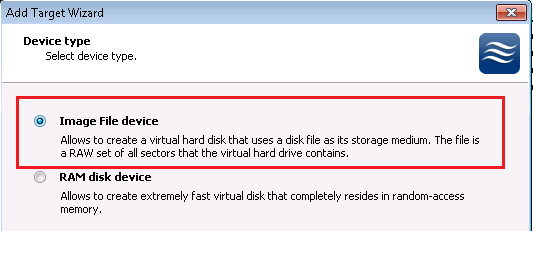
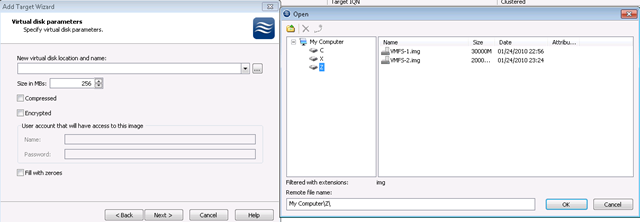
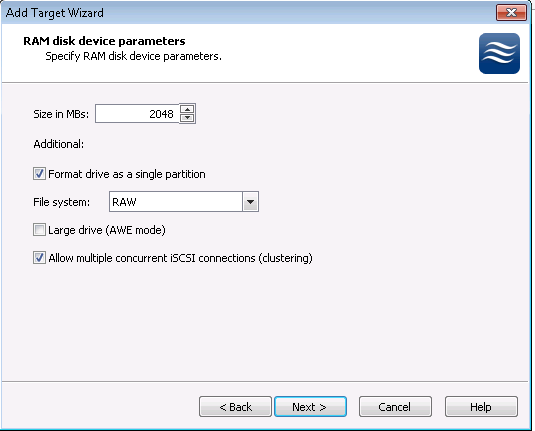
I found this very clever feature in the StarWind vSAN product that allows you to allocate a chunk of physical memory on a host (i.e real RAM) and present it out as an iSCSI target – imagine the possibilities for running virtual machines from that? watch this space 🙂
\

 Virtualization, Cloud, Infrastructure and all that stuff in-between