Virtualization, Cloud, Infrastructure and all that stuff in-between
My ramblings on the stuff that holds it all together
Top Marks for Amazon Customer Services
Posted by on February 21, 2010
I have been doing some experimenting with a cheap-ish SSH drive that I purchased last year; over the last week it has become unreliable and got to the stage where I could no longer remove any partitions, even using DBAN and clean OS installs reported a disk error.
It was past the 30 day normal returns window but had a 2-year warranty – quick email to Amazon customer services and they replied within 30mins that they had shipped out a replacement drive and I just need to return the faulty one within 30 days.
True to their word it arrived before 10am the following day (a Saturday, no less) – 18hrs from 1st reporting the fault, brilliant!
I’ve also been an Amazon prime subscriber for about a year now and it’s been well worth the cost (c.£50/year) as I get almost everything delivered next day included in that flat annual subscription (marketplace stuff isn’t included). if you are lucky enough to live in a covered area it also has special (extra cost) options for getting certain items delivered at specific evening/weekend times – which is very handy if you are having things delivered to home rather than work
It’s got to the stage now that I find Amazon so convenient that I use it for a lot of stuff now, even if I could get it slightly cheaper elsewhere – the quick delivery and general no-hassle returns/order management make it worthwhile for me, plus they are usually very competitively priced.
Easy to see why they are so successful!
HP Installable build of ESXi 4.0 Update 1 PSOD on an HP ML115 G5
Posted by on February 19, 2010
If you have a supported HP server and you need to install ESXi either on a flash drive or a local HDD you should really download the HP-specific build from this link, rather than the one you would download from vmware.com as it includes all the HP CIM providers to allow hardware monitoring – you don’t get those out of the box from VMware.
However, the ML115G5 that I have in my lab isn’t technically on the HP HCL for ESX4 however it works perfectly with ESX4 classic and the VMware-downloaded ESX4i build (as shown here)

When I try installing the HP-specific ESXi build on it I get a PSOD shortly after boot and it’s game-over.
Techhead is aware of this problem, and has a post on a workaround for retro-fitting the CIM agents to the standard VMware build in the pipeline, so for now just use the standard ESXi build from VMware if you have an ML11x for your lab – and bear in mind this isn’t a production system – it’s a lab – think twice if you are wanting to do this for real use – it’s technically unsupported.
Microsoft Tech-Days London – Free Technical Events for IT-Pro’s and Developers
Posted by on February 17, 2010
Microsoft have just announced a series of 5 “tech days” in central London, covering the following topics for IT Pro’s on W/C 12th April

Virtualization Summit – From the Desktop to the Datacentre
Office 2010 – Experience the Next Wave in Business Productivity
Windows 7 and Windows Server 2008 R2 – Deployment made easy
SQL Server 2008 R2 – The Information Platform
Looking ahead, keeping the boss happy and raising the profile of IT
It’s free to attend and although the full agenda hasn’t been released yet but I would hope they have a decent amount of technical content.
There are also similar tracks for developers.
You can read more about the ITPro days it here and the developer days here and you’ll need to register as I would think they will be booked up fast
You can also follow them on twitter for more information or with the #uktd hash-tag
Problems with HP EliteBook and built-in un2400 3G Modem
Posted by on February 11, 2010
I recently got a new laptop, an HP EliteBook 8530p; it’s quite a powerful machine and importantly for me has 8Gb of RAM and dual HDD’s which is very useful for the increasing number of VMs I have to carry around and run.

Rather usefully it comes with a built in HP un2400 3G modem behind the battery, this is a really useful feature and is better than the USB dongles you usually get as there is no chance of dropping the laptop and snapping it off or breaking the USB port.
Unfortunately I had several problems with the x64 Vista OEM build the machine was supplied with, after resuming from sleep it was unable to find the 3G modem and would stoically refuse to recognise that it had one installed or work at all after the 1st connection.
 Some posts on the web indicate this was fixed with an updated version of the HP Wireless Connection Assistant so I installed v3.5 from this page and the updated HP Connection Manager 2.0 (default build had v1.1) that seemed to sort of fix the sleep/resume problem but it still wasn’t working 100%. A forum post led me to turn off this option in the HP connection manager application, but still no joy
I wasn’t overly impressed with the quality of the drivers so went on a hunt (as you do) for newer ones.
Oddly if you look at the normal HP driver download page for this laptop it only lists a driver from June 2009 which doesn’t work, after some investigation with the HP RomPaq download tool it seems there is a newer driver on their FTP site, just it’s not listed on the web page – this driver is the most recent one version – 3.0 (details here) (sp45888 driver download here)
On 1st attempt just running the .exe it still didn’t work properly and didn’t install the driver, I had to extract the sp45888.exe file and run the C:\SWSetup\SP45888\Qualcomm\QCUSBDriver\setup.exe file rather than the setup.exe in the root of the SP45888 directory as you would normally do.
This setup app gives you a UI and lets you choose the carrier and contract type.
Once this was installed it worked ok. not the best quality control HP! – hope this post helps someone else with the same problem.


 As a side note – HP do you really need to have this many 3rd party apps, tools and drivers installed (and requiring updates) in the OEM build!?
sure there is an updater utility… but that’s a lot of build maintenance for people running lots of these machines?
Upgrading to a new PC in stages using VMware Converter
Posted by on February 8, 2010
If like me you travel around a lot and are pretty busy finding the time to get a new laptop setup with all of the data and non-standard build software you require can be a time-consuming chore.
More often than not you will be upgrading to a new more powerful machine with larger disks (unless you are unlucky :)) rather than carrying around two laptops on a trip or risking going without a particular ready to go application why not consider P2V’ing your old laptop onto your new one?
I am doing just this at the moment, I got my new laptop before I had to head out for a couple of days, VMware Converter is a free download and it took me about 3hrs with a cross-over ethernet cable this evening to P2V my old Dell laptop into a virtual machine on my new HP one. and I can now transfer my data and re-install my own applications into the host OS at my leisure; as a side advantage I instantly get the benefits of a machine with a faster CPU and better screen resolution without having to mess around with the software build or “personalisation”.
VMware Player is also free and you can use a VM in full screen mode, Player even supports Unity mode – this could be a viable long-term solution if it weren’t for the licensing position of having to maintain 2 x OS licenses (guest and host).
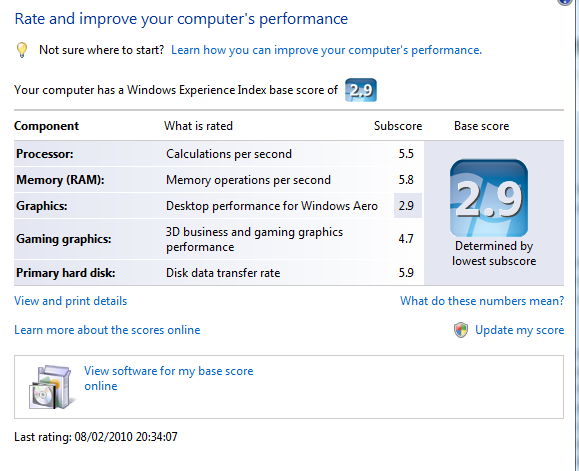
Performance is also pretty good – my VM’d laptop gets a 2.9 performance score in Vista – with the video being the lowest score.
Before (physical Dell D620, 2GHz Dual Core Intel, 4Gb, 200Gb, c.3yrs old)

After VM running under VMware Player on an HP EliteBook, 2.8GHz Dual Core Intel, 8Gb RAM, 250Gb HDD
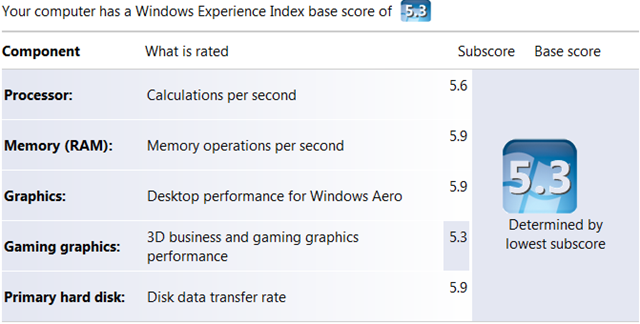
And, for comparison on the native hardware of the new HP Laptop
Keep it in mind next time you switch…
The Fantastic Tavern: London
Posted by on January 28, 2010
Bit of a diversion from the norm this evening, I attended an event called “The Fantastic Tavern” – which is a community focused series of events on a variety of creative and social-media type topics, as I normally live on the infrastructure side of bringing such concepts to life I thought it would be good to get a better feel for what’s coming and some of the thought behind it, oh yes and there was an offer of free beer and sausages…. how could I resist? 🙂
This evening’s topic was “2010 Trends – what’s hot and what’s not” and is set as a series of short 5 minute presentations by people in the creative industry – similar to the lightning talk format used at Cloudcamp. they made innovative use of a cool wall (Top Gear fans will know what I’m talking about :)) to rate the trends as hot or not through some alcohol fuelled volume based popularity measurement techniques (a.k.a shouting).
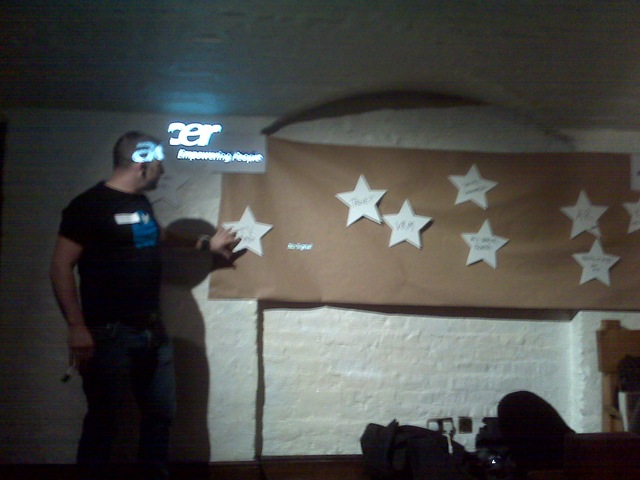
The evening was hosted by Michelle Flynn (Communities manager at EMC Consulting) and well compered by Matt Bagwell (Creative Director at EMC Consulting) these are my thoughts on the most interesting of the talks;
Augmented Reality – this is a really interesting technology to me, and he explained some the use-cases and examples of applications already available to find things like free WiFi or the nearest tube station in a visual manner – very clever stuff, I personally think this is a going to be big this year and next with the array of uber-smart phones like the iPhone and Android equipped devices with built in GPS/compass etc.
This video is a demo from one of the app makers..
Realtime – twitter, and other social networking sites have meant that information is out there very quickly for public consumption you can express your opinion brutally and loudly – this can have a big impact on brand image – poor service @your local Starbucks?, it’s all out there for people to search and read – instantly.
This can be risky – flippant, off-the-cuff remarks can have repercussions and it’s all to easy to broadcast something ill-thought out in the blink of an eye and regret it later.
Some people have used this as a great marketing hook, there was an example of a person in SF who sells Creme Brulee from a cart in the street; he has built up a massive almost cult-following by only announcing his location via twitter when we sets up, if this were “just a guy with a shop” would he have such a loyal and keen, repeat customer base? – he obviously makes creme brulee 🙂 but he has a marketing “hook”.
Behavioural Architecture this is a field of thinking being championed by Dan Lockton at Brunel university and I found it quite interesting, it’s about designing sites or services to make people want to use them, through some subtle social psychology; there was a good example of rewarding positive/healthy behaviour (like the piano stairs below) or features in facebook like the ‘like’ button and suggestions of things to do to engage further with your fb friends like completing profiles.
Playfulness – it sounds obvious but making something fun to use, encourages people use it, there was an example of Chore Wars which is an online game where you can gain a reward (points/stars/etc.) for completing chores – ideal for kids, make it a game, it’s less like work.
There was also a great example of a bottle bank turned into an arcade game
we need some of these where I live! 🙂
Truth – playing to the points of the realtime session and the concepts of citizen reporting, as an organisation it’s so easy to be caught out if you are not being truthful, you can be so visible online that any person can point out if you are being inconsistent and that can carry heavy damage. the realtime world also means we (the consumer) can be very intolerant where things don’t go our way, what customer service slights we may have previously just forgotten about and moved on from are now broadcast in CAPS and shouty !!!! to anyone that cares to listen, and more importantly it’s all there, on-record.
Transparency is becoming increasingly important and from my perspective movements like the blog with integrity programme are this in action; reputation is everything, and there was a poignant example of Tiger Wood’s recent fall from grace and the resulting fall-out
The 30-second TV ad is dead – argued the position that ad’s that are distributed online are much more likely to reach their target audience and get better engagement than the traditional linear 30-second TV advert.
I can see the logic to this, online ad’s can be made interactive and non-linear with click through and the ability to send to friends/share as this screen capture from YouTube illustrates
There was an example video shown of an interactive advert (with some naked people and strategic blue buttons that I couldn’t find online…:)) and a Toshiba advert that appears totally irrelevant to the product they were selling but got a lot of traffic.
Whilst it wasn’t explicitly mentioned this sort of model also has a much better way of measuring return on investment, you can very quickly get feedback on how well your ad is doing, click through rates, conversions to sales etc. – this is almost impossible with traditional linear TV advertising (although some of this is coming to more advanced IP-enabled STB’s)
Social Retail/Commerce – this was particularly interesting and one I have already been a consumer of; sites like Amazon make algorithmic recommendations to you, based on what you have viewed, social networks add a second dimension – social theory says that “people generally like people that like what they like” (try saying that after a few free beers !:)) recommendations from people in your “network” carry a lot of weight, and this is definitely something I have seen in the music space already.
Ratings and recommendations are also a key decision influencer, I always check out the reviews on Amazon, because they are from people (well, mostly from real people anyway).
Companies like yub.com and mflow take this a step further and offer to pay a commission on purchases that you recommend to your network (or are discovered through your network) – much like the Amazon affiliate system that I have used in the past on this blog, but extended into your social network.
His little friend Last up was Michael from Microsoft talking about the ways developments in mobile devices like pico projectors can be used to add an extra level of presence to social networking, using an example of your facebook friend being projected on a wall during a chat session from a mobile device, rather than just a normal small screen.
I had to feel for him as this is a highly visual topic but the promised internet access wasn’t available so he had to ad-lib it, but did very well.
Microsoft have some interesting demonstrations on this in Project Natal
and there was the SixthSense demonstration shown as part of the TED talks which is very cool – maybe a little bit of Minority Report in action
In the end the result was that Playfulness/Fun was voted the hottest trend for 2010, personally I disagree – I think it’s going to be social retail/commerce and augmented reality as they both have a strong potential for quick and easy monetization, with the SixthSense stuff coming to fruition around 2013/14 – no doubt I’ll be wrong, but it’s very cool.
Realtime is also a hot-topic now, but that’s so 2009 🙂
All in it was a fun evening, it’s quite refreshing that the presentations were entertaining and a lot less staid than the usual technical stuff I attend (we techies have a fair bit to learn about audience engagement during presentations), there was a liberal garnish of swearing too, which further goes to prove the truthfulness/honesty trend for 2010; if something is crap – tell it like it is and people will trust you 🙂
Next London event is likely to be in April, with an event scheduled in New York in early Feb, I highly recommend it!
Running a VM from a RAM Disk
Posted by on January 26, 2010
I posted earlier about some of my experiments with the FusionIO solid state storage card, SSD’s and the feature I spotted in Starwind to create a virtual disk from RAM – these are the quick results I see when running a Windows 2003 R2 virtual machine from a RAM disk.
This is done by creating a RAM disk on a Windows 2008 x64 machine running the StarWind vSAN software. the physical machine is an HP ML110 G5 with 8Gb of RAM.


In this test I allocated a 6Gb RAM disk on the vSAN host and shared it out via iSCSI to a vSphere 4 host running on an HP ML115 G5, where it shows up as a normal LUN and vSphere is unaware that it is actually physical RAM on a host elsewhere rather than a normal spinning disk (virtualization/abstraction :)).
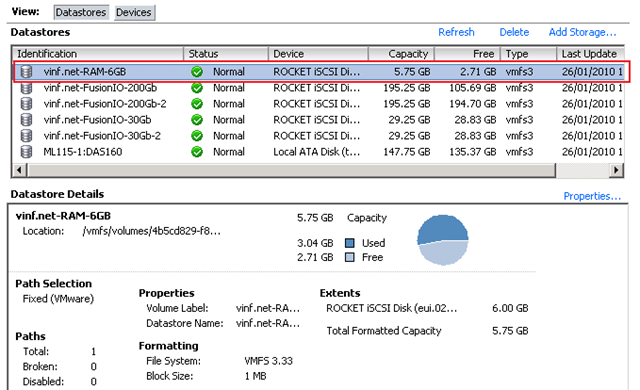
I deployed a single Windows 2003 R2 virtual machine into the 6Gb LUN via the usual processes with thin-provisioning enabled.

The topology for this test looks like the following;

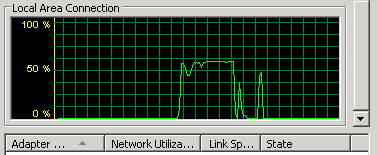
As with previous tests, and based on Eric’s work I used HD Tune Pro (trial) to get some disk access statistics; during the test the iSCSI traffic used c.50% of the bandwidth on the physical box running the Starwind software.
These are the results; which you can compare to Eric, Simon Seagrave and my FusionIO results.
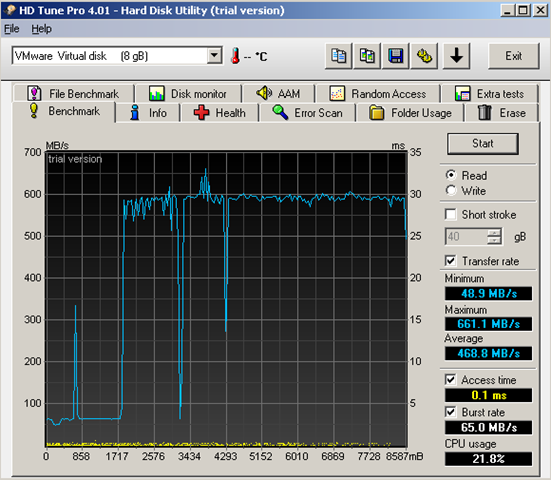

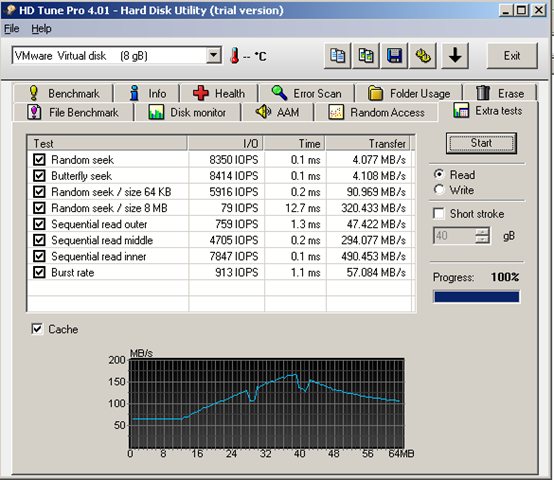
So far I have only done read speed testing, as write-testing requires some extra virtual disks – I’ll get this done in the coming weeks.
There is no escaping the fact that physical RAM is still expensive in quantities sufficient to meet the size of normal VM storage requirements. There are commercially available hardware SAN products that use this sort of concept like the RAMSAN and FusionIO but this is definitely the way the industry is going in future.
Thin-provisioning, linked-cloned and automated storage tiering (like EMC FAST) are going to be key to giving this level of performance whilst keeping costs low by minimising physical storage consumption until RAM/SSD prices reach the current spinning disk levels.
These results go to show how this software concept could be scaled up and combined with commodity Nehalem blades or servers which are capable of supporting several hundred Gb of RAM to build a bespoke high performance storage solution that is likely to cost less than a dedicated commercial solid-state SAN product.
In the real world It’s unlikely that you would want to take this bespoke approach unless you have some very specific requirements as the trade-off is that a bespoke solution is likely to have a higher ongoing complexity/management cost and is probably less reliable/supportable – I did it “just because I could”; your mileage may vary 🙂
Share a RAM disk via iSCSI…run VM’s from it?
Posted by on January 25, 2010
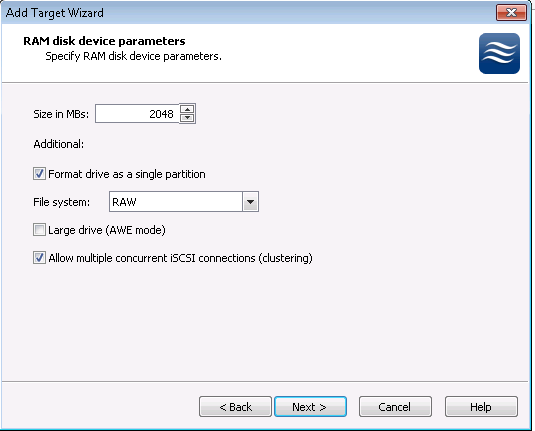
I found this very clever feature in the StarWind vSAN product that allows you to allocate a chunk of physical memory on a host (i.e real RAM) and present it out as an iSCSI target – imagine the possibilities for running virtual machines from that? watch this space 🙂
\
Nothing happens when I try to run Starwind software Manager on Windows 2008 R2
Posted by on January 24, 2010
I am doing some work with a FusionIO solid state flash storage card at the moment (more on this in a future post) as part of this I need a windows based iSCSI target for my testing, and rather handily you can download an evaluation copy of the Starwind Enterprise Edition from here
I usually use OpenFiler for this sort of thing, but not being a particular Linux wizz (ok, and being a bit lazy and in a hurry) I wanted to try out the Fusion IO Duo card I have been loaned, and the Linux drivers are an .RPM or .deb package for which OpenFiler doesn’t have the required package management software – so I have installed it in a Windows 2008 machine and will use the Starwind software as an iSCSI target.
(In terms of disclosure, whilst i was writing this post up last week VMware vExperts were offered an NFR license for the product, this test was done with the freely downloadable eval version rather than the NFR license we have been offered – but I urge you to check it out, it’s pretty cool.
Anyway – when you first install the software on Windows 2008 , there is a Starwind icon on the desktop

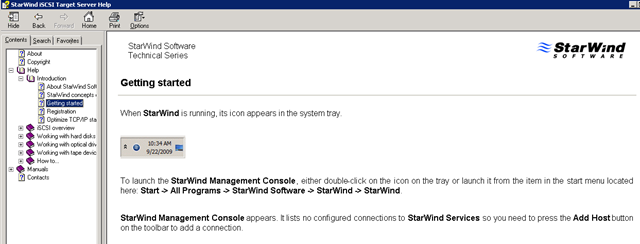
When you double-click on it (or any of the start menu entries nothing happens, you don’t get a UI or anything. this confused me for a while until I discovered that it places a system tray icon on boot, which you use to configure the software.
by default on my Windows 2008 R2 machine this icon is hidden, and set to only show notifications – of which there were none yet.

A quick trip to the customize button on the Notification area menu options on the properties of the task bar shows the default setting which is hiding it
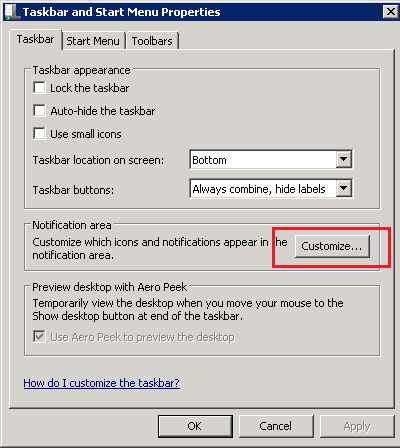

Setting this to show icon and notifications made it re-appear on the taskbar/notification area


You can now right-click and launch the management console 
The management console
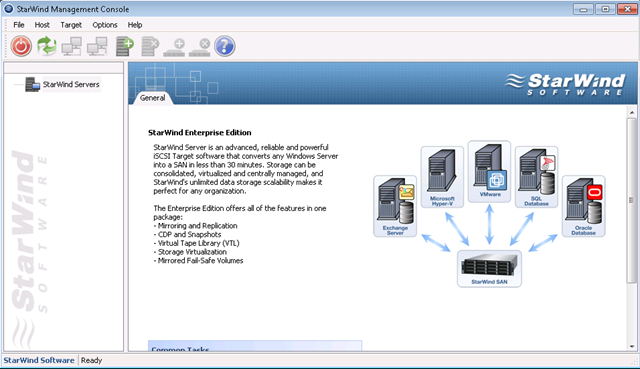
It’s a bit strange that the desktop or start-menu icon doesn’t launch the manager ‘out of the box’ with Windows 2008 – but this is how to resolve it, the hint eventually came from the online help, which said to go via the system tray icon, so it just goes to show – maybe sometimes you should look at the help files!
Hopefully that will save you some time with your eval!
Using the VCE/vBlock concept to aid disaster relief in situations like the Haiti Earthquake
Posted by on January 16, 2010
Seeing the tragic events of the last couple of days in Haiti played out on the news spurred me into evolving some thinking that I had been working on, the sheer scale of infrastructure destruction left by the earthquake in Haiti is making it hard to get relief distributed via road, so airlifting and military assistance is the only realistic method of getting help around.
Whilst providing physical, medical, food and engineering relief is of paramount importance during a crisis, communications networks are vital to co-ordinate efforts between agencies, it is likely that whatever civil communications infrastructure, cell towers, landlines etc. are badly impacted by the earthquake so aid agencies rely on radio based systems, however as in the “business as usual” world the Internet can act as a well-understood common medium for exchanging digital information and services – if you can get access.
Crisis Camp is a very interesting and noble concept for gathering technically minded volunteers around the world to collaborate on producing useful tools for relief staff on the ground, missing people databases, geo-mapping mashups on Google Earth etc. using open source tools and donated people time makes this a free/low-cost soft-solution for relief agencies.
However, with the scale of infrastructure destruction in large disasters getting access to shared networks, bandwidth and cellular communications networks on the ground is likely to be difficult – in this post I propose a vendor neutral solution, whilst I reference the VCE/vBlock concept which is essentially an EMC/Cisco/VMware product line; the concept of a packaged, pre-built and quick to deploy infrastructure solution can apply equally to a single or multi-vendor “infrastructure care package” – standardisation and/or abstraction are the key to making it flexible (sound familiar to your day job?) by using virtual machines as the building blocks of useful services able to run on any donated/purchased/loaned hardware.
These care packages would typically be required for 2-3 months to aid disaster relief during the worst periods and whilst civil infrastructure is re-established. None of this stuff is free in the normal world, it’s a physical product, it’s tin, cables, margin and invoices but is flexible enough that it could be redeployed again and again as needs dictate, with my UN or DEC hat on this is a pool of shared equipment that can be sent around the world and deployed in 24hours to aid on the ground relief efforts, donated, loaned by vendors or sponsors.
What is it?
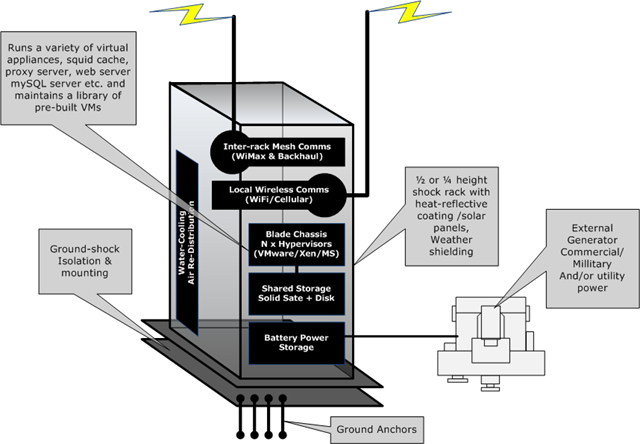
A bunch of low-power footprint commodity servers, storage and communications gear packed into a single, specialised shock-rack with a generator (gas/diesel/solar as available) and battery backup.
It makes heavy use of virtualization technologies to provide high-availability of data and services to work around individual equipment and/or rack failures due to damage or loss of power (generator out of fuel or localized aftershock etc.)
Because systems running to support relief operations typically will only be required for short term use, virtual appliances are an ideal platform, for example a pre-configured database cluster or web server farm, technologies like SpringSource can be used to deploy and bootstrap web applications around the infrastructure into virtual appliances.
Data storage and replication is achieved not using expensive hardware array based solutions but DAS storage within the blades (or shared disk stores) using virtual storage appliances like the HP Lefthand networks VSA or Celerra VSA or OpenFiler – allowing the use of cheap, commodity storage but achieving block-level replication between multiple storage locations via software – each blade uses storage within the same rack, if access to the storage fails it can be restarted on an alternative blade or an alternative rack (like the HA feature of vSphere)
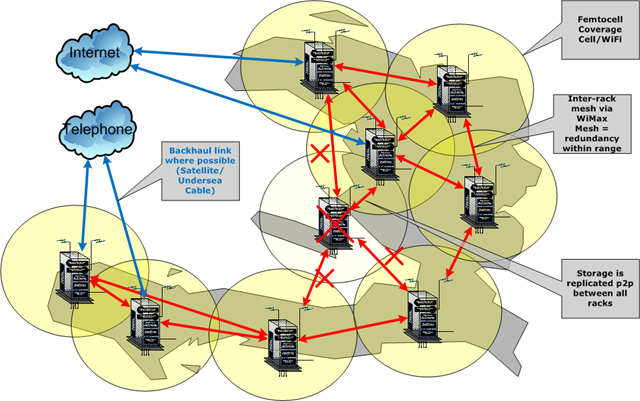
These racks are deployed across a wide geographic area – creating a meshed wireless network using something like WiMax to handle inter-mesh and backhaul transit and local Femtocell/WiFi technology, providing 3 services
- private communications – for inter rack replication and data backhaul
- public data communications – wireless IP based internet access with a local proxy server/cache (backhaul via satellite or whatever is available – distributed across the mesh)
- local access to a public cellular system femtocell (GSM, or whatever the local standard is)

The availability/load balancing features of modern hypervisors like VMware’s HA/DRS and FT technology can re-start virtual machines to an alternative rack should one fail. Because the VSA technology replicates datastores between all racks at a block level using a p2p type protocol it’s always possible to restart a virtual appliance elsewhere within the infrastructure – but on a much wider scale and with a real-impact.
Ok, but what does it do?
Even if you were to establish a meshed communications network to assist with disaster relief activities on the ground, bandwidth and back-haul to the Internet or global public telecoms systems will be at a premium, chances are any high-bandwidth civil infrastructure will be damaged or degraded and satellite technology is expensive and can have limited bandwidth and high-latency.
The mesh system this solution could provide can give a layer of local caching and data storage, thinking particularly with the Google Maps type mashups people at Crisiscamp are discussing to help co-ordinate relief efforts that can require transferring a large amount of data – if you could get a local data cache of all the mapping information within the mesh transfer times would be drastically reduced.
this is really just a bunch of my thoughts on how you can take current hypervisor technology and build a p2p type private cloud infrastructure in a hurry, virtualization technology brings a powerful opportunity in that it can support a large number of services in a small power footprint; the more services that can be moved from dedicated hardware and run inside a virtual machine (for example a VoIP call manager, video conferencing system or GSM base station manager) mean less demand for scarce fuel and power resources on the ground; and virtualization brings portability – less dependence on a dedicated “black-box” that is hard to replace in the field, virtualization means you can use commodity x86 hardware, and have enough spares to keep things working or work around failures.
The technology to build this type of emergency service is available today with some tweaking. The key is having it in-place and ready to ship on a plane to wherever it is needed in the world, some more developed nations have this sort of service in-country for things like emergency cellular networks following hurricanes but it will need a lot of international co-operation to make this a reality on a global scale.
Whilst I’m not aware of any current projects by international relief agencies to build this sort of system I’d like to draw people’s attention to the possibilities.
The DEC are accepting donations for the Haiti earthquake relief fund at the following address.
or the international red-cross appeal here

 Virtualization, Cloud, Infrastructure and all that stuff in-between