Virtualization, Cloud, Infrastructure and all that stuff in-between
My ramblings on the stuff that holds it all together
Yeah Web 2.0 makes your life easier
Posted by on November 15, 2007
Have to admit it I’ve been a bit slow to get on the whole 2.0 bandwaggon – YouTube/Facebook/Blogging other than following a lot of blogs for a couple of years.
But I have now arrived, and found a use for some of it 😉
I recently purchased a Blackberry 8800 from eBay to try it out.
I’ve always been a Treo or Windows Mobile user and hated Blackberry with a passion; mainly because I don’t like the way you have to have an extra data “service” to use their forwarders and a BES etc.. but thought I’d check out the new Blackberry handsets as colleagues seem to rave about them (thats a whole future post..)
Anyways; the handset had a fault which is tricky to explain but easier to demonstrate. It seems to stem from a loose connection and the handset reboots itself when tapped in a certain way.
So, rather than risk sending it back and the vendor not understanding or being able to reproduce the fault. I took a quick and dirty video using my digital camera (finally found a use for that feature ;)). and uploaded it to YouTube – sent the link to the vendor and they agreed it looked faulty and would need replacing.
No hassle, no argument no fuss and it was an easy way to show them how to repro the fault without being there in person.
video here if you are interested (might want to turn off the sound my voice sounds awful IMHO!) 😉
Anyways big recommendation for Phone Efficient who sell reconditioned/new handsets via eBay… great service and quick to respond, and refunded the return postage costs. Very recommended!
The Traditional Approach to Test Labs & Why I Think it’s Wrong..
Posted by on November 12, 2007
If you’re an infrastructure person there are all kinds of business drivers and company schemes that mean you are often getting mad-cap requests** for changes to your nice, stable, secure infrastructure that lets everyone get on with their job and not have to worry about it.
Not all of them make sense, hopefully most of them are worthwhile but they all need to be done NOW!.
Now, as much as they would like you to, you’re unlikely to give John Doe, head of marketing full access to install complicated software like Microsoft Symantec CA WizzBang Enterprise v666sp4 into your production environment without some kind of testing.
Why?*
- if the production system falls over once someone has installed it people are going to come and beat you until you get it going again
- It’s seemingly innocuous & lightweight (the salesman said so…) data exchange agent that you need to install on all your key hosts may have some nasty incompatibilities with your standard installation – for example it breaks the AV agent or vice-versa, it needs a .net framework that is incompatible or untested with your production .net apps.
Herein lies the problem, you need to install it to check it out, run it against your standard configs, builds, apps etc. and achieve a reasonable level of confidence that the moment you click setup.exe it won’t be a case of not seeing your family again for a long time as servers and networks come crashing down around your ears.
The traditional approach to doing this, and I say traditional as this is what I’ve seen MSCS and all the big consultancy orgs and vendors recommending. Is to get a bunch of servers install the OS and the new app and see what happens.
This has a number of problems in my eyes.
It’s a vanilla/fresh install, it doesn’t have all the upgrades, patches, badly uninstalled apps, lurking data corruption issues that your production hosts have been exposed to.
Change control – great you’ve got it, and everyone has been on the ITIL courses but there is ALWAYS deviation from standard config.
I’ve yet to see any installation that looks exactly like the CMDB says it should, It’s both a management and a technical issue;
- Engineers are people, if someone is on the on-call rota and something needs fixing at 3am they may hack away at it to get things running again, it doesn’t necessarily mean they can remember every non-successful change they made the following morning when they update the problem ticket and incident report.
- Every app under the sun want’s to auto update itself these days, are you really 100% confident you have regression tested every combination of Windows Updates etc. – particularly security updates where there is a security compliance driver to get them out ASAP.
- There is a huge amount of inter-dependency in Windows infrastructures, apps rely on authentication, which relies on AD, which relies on a bunch of .DLLs, which rely on an OS, which relies on sub-components that rely on drivers, frameworks, runtimes etc. if you build from scratch can you really capture all of them – particularly on those hosts that have been around since the dawn of time and nobody knows exactly what they do or, sometimes where they physically (apart from that contractor that left last week :)). are but when they go wrong you know about it straight away.
- someone may have adjusted permissions or group memberships in AD or on a server at some point in the past in a way that would cause that app to fail but would not be picked up by just installing a server and the new app.
I’m not advocating spending so much time testing that the change you wanted to implement is out of date by the time you’ve finished; you’ll never catch everything but within this group of posts I’m hoping to propose a more pragmatic approach using copies of real systems and real data rather than just making some up and hoping for the best.
it’s always easier to install something in a clean environment than in an existing one.
*are you new here?
**For example; “Hi, are you the computer people? We’ve decided to re-brand the company this week and we need to change the Active Directory domain name thing to wizzynewcorpname.net, oh yeah and we need it doing at 1pm tomorrow in-line with the press release, thanks <click>” (yep, that’s a real example!)
Technorati Tags: Build a Better Test Lab , change control , CMDB , ITIL , mad company schemes , test Lab , test
Eye Fi Wireless SD Card
Posted by on November 12, 2007
huh?
Now this looks like quite a cool idea, if I read it correctly the SDCard fits any standard camera etc. but you can associate it with a number of WiFi access points (home network, cloud etc.)
any pictures you take it buffers up on the card and if there is a recognized WiFI AP in range with an Internet connection it automatically upload the pictures to your choice of web service – Flickr, Facebook etc.
or you can do the same sort of thing to your home PC.
Interesting idea, and not /that/ expensive @99USD – although that’s likely to translate to £100 using the weird US/UK exchange “rate” for technical kit that all manufacturers seem to get away with use.
http://www.dpreview.com/reviews/eye-fi/
Although I’m not sure I’d want all of the awful pictures I take uploaded for everyone to see without me filtering them 1st 😉 and I wonder what it does to the battery of the device its inserted into?
Managing lots of RSS feeds
Posted by on October 31, 2007
I’ve been into reading people’s blogs and tracking websites like theregister for a good couple of years. I never really found an RSS reader app that worked for me; I wanted to build custom views of feeds, flag and prioritize them and mark things to read later – and I could find standalong apps to do these things but not one that did it all – hopefully this post will show you how I do it – if you have some other suggestions feel free to comment & share them.
Outlook 2007 supports RSS feeds out of the box, and it’s ideal as I already use Outlook and it’s calendar/tasks features to manage my workflow. Outlook 2003 and later (I think) added the ability to flag and tag items and even build a custom category list.
It means I can basically add all my RSS feeds as sources of information in the same way as I use it to manage my company emails, and categorise, flag as required and it all merges with into task list.
I can do this categorization manually or I think automatically via a rule
Custom Categories
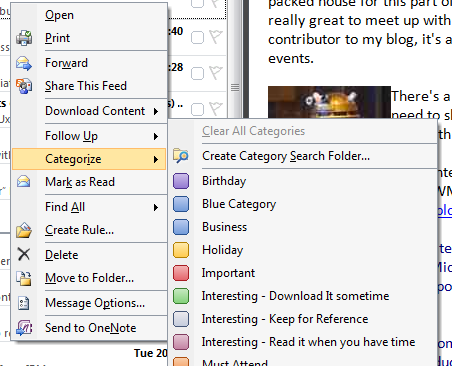
Flagging – which passes it into Outlook’s task list
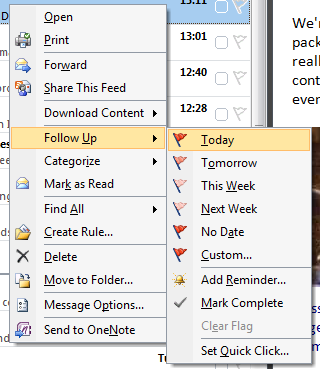
I have two main folder/sub-folder structures – regular reads, for feeds that have a lot of frequent/interesting traffic and another folder/sub-folder structure for less noisy but important feeds (for example software release notifications etc.)

Best of all I can build custom views across of all my RSS feeds using custom search folders – for example I have the following (yes, and lots of unread emails too!)

And this gives me the following consolidated view across all my feeds, sorted by date (but could be lots of other criteria)
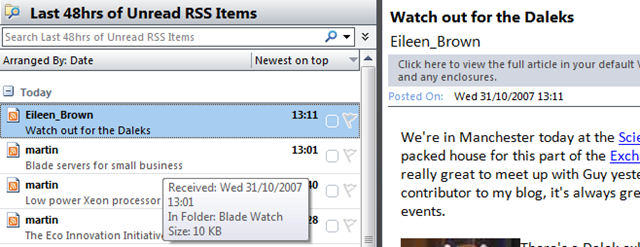
The add feed GUI components definitely have the feel of an afterthought but using them works brilliantly for me. Clicking on a page’s RSS feed brings up Outlook but doesn’t want to add it as a feed so I’ve always cut & pasted.. I assumed this was a beta bug but have been using RTM for quite a while now – must get round to investigating that.
Technorati Tags: Microsoft , office , 2007 , Outlook , Cool ways to do things , RSS , managing feeds
Tiny Laptop for £229 with solid state HDD
Posted by on October 31, 2007
I generally wouldn’t touch anything other than a Dell/HP/IBM laptop with a bargepole for reasons of spares availability/cost… but at £229 inc VAT this is almost disposable if something dies.

It’s tiny and has a (small) solid state HDD but SD card reader slot to allow you to add more storage space.
Review here..
http://www.cnet.co.uk//i/c/rv/e/laptops/asus/eee_pc/asus-eee_pc-440x330_2.jpg
Expansys are going to have them soon..
http://www.expansys.com/p.aspx?i=158485&partner=froogle
No Bluetooth but has a £40 option for adding an integrated 3G modem very cool.
I had a P133 Toshiba Libretto years ago and it was ace.. I like the idea of this..
Linux OS only at the moment (+VMWare maybe?) but WinXP in near future
And a bit of an update to this post Bryce posted a great link to a site covering upgrades to this mini notebook – 2Gb RAM upgrade, how to install other software & WinXP. Must, resist… must… http://www.notebookreview.com/default.asp?newsID=4062
HP Builds "Smart-cooled" Datacentre in Bangalore
Posted by on October 31, 2007
the following article details how HP are consolidating 14 datacentres into 1 and taking a smart approach to cooling.
Rather than uniformly cool the datacentre thousands of temperature sensors installed in racks feed back readings to the cooling control system so hot spots can be automatically cooled.
Be cool (ha ha) if HP made this an open specification or product that you could pull all the readings from the datacentre racks and individual servers/blades to control your HVAC systems.
This is ideal for "dynamic" datacentre environments or grid based systems where you might ramp up performance/utilization (and thus power/cooling requirements) in a set of blades and have the HVAC automatically compensate rather than having to physically install the kit with sufficient dedicated space/cooling from day 1.
http://www.techworld.com/green-it/features/index.cfm?featureID=3764&pagtype=all
Interestingly, also mentions the utility power supply being more expensive and unreliable in Bangalore than in the US so they are supplementing the utility power supply with Diesel generators which somewhat harms their overall carbon footprint argument.
Guess the government must be building big comms infrastructure in India to support the booming tech industry over there, cheap labour/construction cost etc. is probably how they forecast such a quick ROI compared with the US/RoW.
And surely, if your datacentre is in a country with a hot climate you’ll spend/use more power over the year than hosting in somewhere like Iceland?
Microsoft DHCP Team Blog
Posted by on October 26, 2007
Might be useful to someone, some handy hacks and scripts for doing useful DHCP things, I always found MS DHCP servers lacking these sorts of interfaces to do have DHCP help with "clever" things on Windows infrastructures – particularly in migrations.
http://blogs.technet.com/teamdhcp/default.aspx
These kinds of sites are an example of the good ways blogs can help improve companies images by allowing you to communicate in a manageable fashion to people at the coal-face.
Dick vs Microsoft
Posted by on October 24, 2007
I’ve subscribed to Dick Morrell’s RSS feed for donkeys now, partly cos I find his rants entertaining and mainly because they contain some useful information about interesting OSS projects, heck I even used and donated to Smoothwall in the days before cheap ADSL routers and still use smoothwall/IPCop as a quick way to get some basic firewalling into my VM test environments.
I first encountered Dick when he was at Smoothwall and his inter-personal skills were highly entertaining, if a little tactless when dealing with people on their mailing lists/IRC (I’m sure there’s an archive somewhere if you are interested)
When I saw his post about Eileen Brown* on Monday I wondered how long it would be before the buns started flying, I’ve met Eileen a couple of times and was quite sure she wouldn’t just let it slide.
But does it really warrant legal action? can’t we all get along </hippy mode> I’ve seen far worse & personal come from Dick’s hand to others on the net!
Linkage here so you can make your own mind up…. maybe my signed Smoothwall Xmas card will be worth something on eBay now 😉
http://blog.dickmorrell.org/ and http://blogs.technet.com/eileen_brown/archive/2007/10/19/evangelism-or-marketing.aspx and http://blogs.technet.com/jamesone/default.aspx
*Another blog I follow as it’s very useful for Exchange stuff
Building a Better Test Lab
Posted by on October 22, 2007
This is the outline of a number of posts on building a {relatively} low-cost accurate test lab of your production systems using P2V, VMWare, ESX, custom scripted HP voodoo, HP MSA1500 SAN, Virtual Switch Tagging (VST), Checkpoint on Sun Firewalls and Cisco switches. in order to clone a complicated multi-tier Windows based production platform with lots of DMZ segments into a VMWare farm for use as a test/dev & development environment (and possibly a DR one too in future)
This is all based on some of my recent work with customers* and I hope will help someone else to navigate the pitfalls (both business and technological) I & my team encountered in delivering this idea.
The following is a list of titles or sections and will hopefully serve as an index, but please, don’t expect them all at once I do have a day job to do! 😉
Why do this?
The traditional approach to test labs & why I think it’s wrong
Pro’s
Con’s
Isn’t this all a bit too complicated/mad-scientist/far out?
Reload lab from production process – how often?
is change control important?
What do you want a test lab to do?
Scoping/Expectation Setting
Load Testing – is VMWare right for this
Dynamic/Grid based approach to load testing
Break/Fix analysis
Release Testing
Options for disaster recovery/production failover
What won’t it do?
Storage Design
“Big” SAN’s are always better if you have them, but what if you don’t?
HP MSA 1500 – it’s not big, but it’s clever
Disk/SAN bandwidth – my practical experiences
Server Design
ESX Node specification
The RAM per VM debate
Networking Design
VLAN tagging
VST vs. Guest Tagging etc.
Firewalls
Clone to test lab Process
P2V Tools – VMWare Convertor vs. the rest
Changing IP addresses
HP uninstall Scripts
Build-Out Steps
Build ESX environment
Scripted VMWare installations – automatically create custom Virtual NIC’s/LANs
Adjust install paths for SAN storage
Set administrator password/create accounts
Install Networking
Configure VLAN’ing
IP Load Balancing
Install Firewall(s)
Test Communications between virtual DMZ segments and across hosts
Import Production machines
VMWare Convertor
General issues found
P2V Windows 2003 Domain Controllers – Special Notes
P2V’ing entire Windows Cluster’s – not that easy but do-able
P2V Process over a WAN – issues found & workaround.
Fresh VM 1st boot, changing IP address etc.
HP tools removal
Some further problems caused by changing IP addressing.
Into the Future
Can you use this for disaster recovery?
VMWare Lab Manager
Total Automation – Platespin products?
*This article has been deliberately made anonymous & I’m afraid I can’t disclose the name of the customer or provide any further reference materials without a commercial engagement via my employer, you can contact me for more details on this via this blog.
This article & information contained within is provided entirely without warranty.
Technorati Tags: VMWare , ESX , HP , MSA1500 , Test Lab , P2V , production , clone , Sun , Checkpoint firewall , VLAN tagging , VST
Windows Live Writer
Posted by on October 22, 2007
I have downloaded Windows Live Writer as it seems pretty well recommended for people wanting to compose posts off-line.. so here it is 1st blog using it!
Sorry, will try to come up with something more compelling to write about!
I have a couple of posts in the pipeline about building a Virtualised test lab environment on low-end HP SAN hardware, yes an MSA1500!! I can almost hear all the VMWare people withdrawing in horror! but it does work and I can explain why.. more in a couple of days.

 Virtualization, Cloud, Infrastructure and all that stuff in-between
