Virtualization, Cloud, Infrastructure and all that stuff in-between
My ramblings on the stuff that holds it all together
Category Archives: Work
Cisco ASR is Virtual to the Core, all 40 of them!
Posted by on March 14, 2008
Interesting article here on how Cisco have made heavy use of virtualization within their new ASR series router platform, Linux underneath and 40 core CPUs!
This type of approach does make me wonder if we will get to the stage of running traditional “network” and “storage” services as VM’s under a shared hypervisor with traditional “servers”.. totally removing the dependency on dedicated or expensive single-vendor hardware.
Commodity server blade platforms like the HP or Sun blade systems are so powerful these days, with flexible interconnect/expansion options this type of approach makes a lot of sense to me and is totally flexible.
Maybe one day it will go the other way and all your Windows boxen will run inside a Cisco NX7000 lol!
On reflection maybe all those companies have too much of a vested interest in vendor lock-in and hardware sales to make this a reality!
Performance Expectations on a Shared Virtual Platform
Posted by on March 12, 2008
Some interesting discussion linked-to within this article on Storagezilla. people using Amazon’s EC2 platform are complaining because they feel they are getting less performance than they should.
Always an interesting point to bear in mind and useful in expectation setting for developers. You may want a dedicated CPU/core – but do you really need all of that CPU all of the time? in most cases I would guess not; and if you do need that level of performance – shouldn’t you be considering a physical platform rather than a virtual one?
Exchange 2007 SP1 Upgrade Process on a CCR cluster
Posted by on March 1, 2008
I used this process to carry this out – worth bearing in mind that you do need some downtime to the clustered mailbox instance to carry this out – it took about 60 seconds to do that and installing the SP1 code on each passive node took approx 5 mins each + a reboot

Exchange 2007 CCR Configuration Notes
Posted by on February 29, 2008
Once you’ve followed the installation process and have your active and passive nodes setup you may not actually be able to failover and mount the stores – it fails and logs an event 9317 from MSExchangeSA as below;

The fix is to register an SPN for each cluster node as per this KB article – why setup doesn’t do this for you I don’t know?
add-ADPermission -Identity “cn=exchange-cms,cn=computers,dc=mydomain,dc=com” -User “node-cl1$” -AccessRights WriteProperty -Properties “Validated-SPN”
You do this using the Exchange Management {Power}Shell Applet using the following command.
One thing to bear in mind – particularly if you are implementing a CCR cluster across mode than one physical site (single subnet required) you’ll need to wait for each node’s respective AD Domain Controller to replicate the changes.
Once that was completed I could fail over the cluster nodes perfectly.
HP iLo Very Slow for Installing an OS
Posted by on February 27, 2008
A bit of a disappointment; we’re trying to do a WinPE 2.0 CD/DVD based installation for our Windows 2003/2008 standard blade servers in an HP c7000 enclosure.
Installing from a .ISO image presented to the iLo via the virtual media applet is dog-slow (5-10 times slower than from a physical CD/DVD- why is this? – surely its technically possible to make this access run faster and GigE chipsets are cheap-as these days. I’ve been through every combination of switching/duplex/port config and even via a cable directly into the Blade OA.
The same issue seems to manifest itself on traditional rack mount HP servers – the iLo just isn’t fast enough to make this a workable solution, unless you are really patient.
I know we could use the RDP and do it as a PXE type installation over the network to each blade, but this doesn’t really achieve what I want…
Most customers maintain an OoB (Out of Band) network to which all of the management interfaces (iLo, DRAC, etc.) are connected to. the reasoning for this is obvious; if you loose your main core switching network you can get access via a totally different physical network and path to assist in troubleshooting.
For this same reasoning I would like to use this method to build servers from a master boot CD/DVD image, you can present a .ISO image to a server via the virtual media applet on the iLo. We have a fully end-end build process that sets up the HP array controllers, flashes BIOS and installs the OS and drivers etc. from a CD/DVD.
We just update the boot CD .ISO file as required and its flexible and it doesn’t rely on any deployment infrastructure (PXE server, RDP server etc.) so we can port it between customers and data centres, VM’s and physical machines and do a bare-metal builds without requiring any build/network infrastructure in place.
This isn’t just limited to a Windows OS – I tried the same with an ESX installation; took over an hour (compared to 5-10 mins from a local CD)
Support for Virtualized OS/Applications – an Open Debate..
Posted by on February 21, 2008
Martin’s post here prompted me to blog something I’ve been meaning to do for a while.
Virtualization projects and services are cool; we all understand the advantages in power/cooling and the flexibility it can bring to our infrastructures.
But what about support, if you are a service provider (internal or outsourcing) you normally need to be able to offer an end-end SLA on your services. typically this would be backed off against a vendor like Microsoft or Oracle via one of their premium support arrangements.
From what I see in the industry, with most software vendors especially Microsoft there is almost no way a service provider can underwrite an SLA as application/OS vendors give themselves significant scope to say “unsupported configuration” if you are running it under a hypervisor or other VM technology… Microsoft use the term commercially reasonable in their official policy – who decides what this is?
I would totally accept that a vendor would not guarantee performance under a hypervisor – that’s understandable and we have tools to analyse, monitor and improve (Virtual Centre, MOM, DRS, increase resources etc.). but too many vendors seem to use it as a universal “get out of jail free card”.

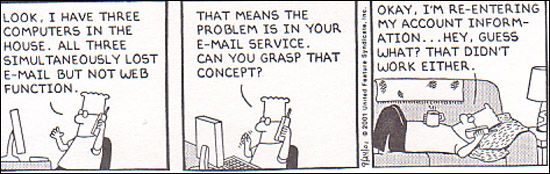
Issues of applications with dependency on physical hardware aside (fax cards, realtime CPU, DSP, PCI cards etc.) In my entire career working with VM technology I’ve only ever seen one issue that could be directly attributed to being caused by virtualization – and to be fair that was really a VMTools issue; rather than VMWare itself.
Microsoft have an official list of their applications that are not supported here – why is this? speech server I could maybe understand as it would probably be timer/DSP sensitive – but the rest? Sharepoint? I know for a fact ISA does work under VMWare as I use it all the time.
Microsoft Virtual Server support policy http://support.microsoft.com/kb/897613
Support policy for Microsoft software running in non-Microsoft hardware virtualization software http://support.microsoft.com/kb/897615/
Exchange is specifically excluded (depending on how you read the articles)
· On the Exchange Server 2007 System requirements page it only mentioned Unified messaging as being unsupportable in a virtual environment http://technet.microsoft.com/en-us/library/aa996719.aspx
· Yet on TechNet it is clear stated that “Neither Exchange 2007 nor Exchange 2007 SP1 is supported in production in a virtual environment” http://technet.microsoft.com/en-us/library/bb232170(EXCHG.80).aspx
Credit due to a colleague for pulling together the relevant Microsoft linkage
But I know it….
a) works fully – I do it all the time.
b) Lots of people are doing this in production with lots of users (many people at VMWorld US last year)
c) VMWare have a fully-supportable x64 hypervisor – It’s just MS that don’t
What is the industry going to do about this?, I asked this question of peers a lot at VMWorld and at BriForum; and to be honest everyone has the same concern but have a few different approaches;
Dont’ tell/ask – 99% of the time a tech support rep won’t know its running under VMWare/a.n.other hypervisor so why complicate matters by telling them – could of course back-fire on you!
Threaten – “If you won’t support under VMWare we’ll use one of your competitors applications”; however this only really works if you are the US govt. or Globocorp Inc. or operate in a very niche application market.
Mitigate – reflect this uncertainty in an SLA, best-endeavours etc. this would kill most virtualization efforts in their tracks for an enterprise customer.
The same support issue has been around for a long time; Citrix/Terminal Services, application packaging, automated installations, etc. are treated as “get out of jail free cards” by support organisations…
But whilst there are some technical constraints (usually only affecting badly written apps) with terminal services and packaging, virtualization changes the game and should make it simpler for a vendor to support as there is no complex runtime integration with a host OS + bolt-ons/hacks it’s just an emulated CPU/disk/RAM you can do whatever you like within it.
So – the open debate; what do you do? and how do you manage it?
Please comment…
P2V Backup & Disaster Recovery
Posted by on February 20, 2008
There is a new site here (disclaimer: it does seem to be promoting a commercial service, but has some useful information that has been put into the public domain); describing some methods to roll your own P2V backup approach; I’ve not read in detail yet; but looks like Frane Borozan has solved some of the challenges I’ve encountered in the past automating the Free VMWare Convertor tool.
When I get some time I will revisit my build a better test lab series (and update it!) I hope to be able to integrate some of Frane’s ideas.
Thanks to Techhead for passing on the link; we worked together on the platform underlying the Build a better test lab series and he did a lot of work on the P2V and post-P2V automation tasks – he’s got a lot of handy scripts for doing this on an HP platform
Virtualized DR is going to be big this year; I have a long line of customers with this high on their list of priorities… Both for cross site 100% VMWare implementations and for the ability to backup/restore physical platforms to VMWare grid in a DR situation.
It just makes so much sense; no delay whilst racking & stacking recovery kit or problems restoring to different hardware etc. your admin’s can even do it from home – which can have some significant advantages in the event of a natural disaster like Katrina or floods like we had over the last couple of years in the UK
PlateSpin Forge is something we are seriously looking at as well as Symantec Backup Exec System Recovery Server Edition (who win a prize for extending the longest, most annoying product name! despite acquiring it from Veritas).
Will be an interesting year; I’m sure Sungard and all those recovery centre facilities will be moving to a grid/resource rental model rather than pure rack/floor space and retained hardware on-contract.
Make Your own Offline Windows Update CD/DVD
Posted by on February 12, 2008
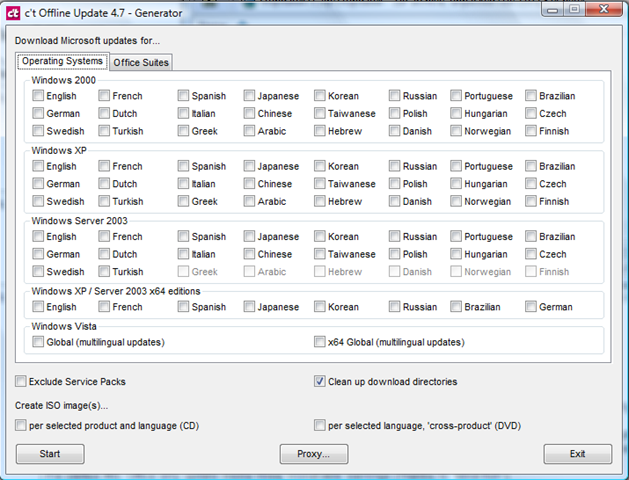
What a handy tool; if you download the app you can select which Microsoft OS/Applications you need patches for and it will download them all via the Windows online catalog to a source directory and then compile a script to auto install them all – it will even generate a .ISO file and handle dependencies and reboots – v.handy (and more efficient) if you need to quickly present it to a bunch of virtual machines with no Internet access or are on a site with slow internet access.
Excellent; now as far as I know Microsoft have no mechanism for doing this other than downloading all the patches manually… even with the Vista RTM images I built last week it had nearly 100Mb of OS patches alone!
Screenshot of the available options in the app – download it here here (updated 14th Sept’09)
OS Updates – multi-language too
Office Suite Updates too
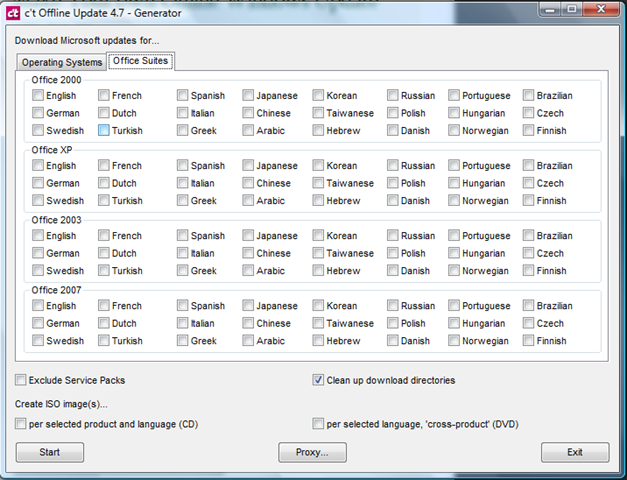
You can even get all the patches for everything and it will compile it into a DVD .ISO image – I’ll definitely be using this – hopefully you can use the info it downloads to slipstream update a vista .WIM image – will have to try that in a couple of weeks.
(original link from a post on slashdot)
Hot-Swap Datacentres
Posted by on February 11, 2008
There’s an interesting post over on Forrester research blog by James Staten. he’s talking some more about data centres in a container; making the data centre the FRU rather than a server or server components (Disk, PSU etc.).
This isn’t a new idea but it I’m sure the economics of scale currently mean this is currently suitable for the computing super-powers (Google, Microsoft – MS are buying them now!) – variances in local power/comms cost could soon force companies to adopt this approach rather than be tied to a local/national utility company and their power/comms pricing.
But just think if you are a large out-sourcing type company you typically reserve, build and populate data centres based on customer load, now this load can be variable; customers come and go (as much as you would like to keep them long-term this is becoming a commodity market and customer’s demand you are able to react quickly to changes in THEIR business model – which is typically why they outsource – they make it YOUR problem to service their needs).
It would make sense if you could dynamically grow and shrink your compute/hosting facility based on customer demand in this space – thats not so easy to do with a physical location as you are tied to it in terms of power availability/cost and lease period.
New suite build out at a typical co-lo company can take 1-2 months to establish networking, racks, power distribution, cabling, operational procedures etc. (and that’s not including physical construction if it’s a new building) – adopting the blackbox approach could significantly reduce the start-up time and increase your operational flexibility
Rather than invest in in-suite structured cabling, rack and reusable (or dedicated) server/blade infrastructures why not just have terminated power, comms and cooling connections and plug them in as required within a secured warehouse like space.


Photos from Sun Project Blackbox
You could even lease datacentre containers from a service provider/supplier to ensure there is no cap-ex investment required to host customers.
If your shiny new data centre is runs out of power then you could relocate it a lot easier (and cheaply) as it’s already transportable rather than tied to the physical building infrastructure; you are able to follow the cheapest power and comms – nationally or even globally.
As I’ve said before the more you virtualize the contents of your datacentre the less you care about what physical kit it runs on… you essentially reserve power from a flexible compute/storage/network “grid” – and that could be anything/anywhere.
Blogging from a Blackberry
Posted by on February 11, 2008

 Virtualization, Cloud, Infrastructure and all that stuff in-between